
The Pictish Civil War Part I
As with the European royal families in more recent times, the ruling classes on the island of Britain in the period before the formation of Scotland and England were often linked by birth.
The Anglo-Saxon kingdom of Northumbria had risen to prominence in the 7th century and many of its aristocrats had connections with the territories to its north. Edwin, King of Deira had been expelled by his brother-in-law, Æthelfrith, king of the other Northumbrian kingdom of Bernicia, sometime before 604. Edwin lived in exile for a number of years before returning to depose Æthelfrith in 616 and ruling over a united Northumbria.
Æthelfrith’s three sons fled north – two to Dal Riada (Oswin and Oswiu) and the eldest (Eanfrith) to Pictland. All seem to have been accepted and looked after by their new hosts, who perhaps could sense the diplomatic opportunities presented to them. The boys would later return home to Northumbria to rule.
One of Edwin’s daughters gave birth to a son in the 620s. The boy’s father was Beli I (king of the Strathclyde Britons). It has been suggested that the child also had some Pictish ancestry; in any case that boy would become known as Bridei map Beli, the Pictish King and conqueror of the Northumbrians at Dun Nechtain in 685. Confusing as the aristocratic breeding rota seems, it does at least allow us some insight into the history as the Annals and other sources concentrate on the deeds of the “nobility.”
Bridei is described in the Annals as “rex Fortenn” – king of Fortriu – but it seems that he was the most powerful of all Picts at the time. He had been brought up at the Northumbrian court and had initially been a supporter of (and subordinate to) Ecgfrith of Northumbria. However as we have seen, this relationship broke down, leading to the defeat of his one-time overlord in 685 and the end of Anglo-Saxon dominance in Pictland, Dal Riada and Strathclyde. Pictland was still an amalgam of various territories and kings, but Bridei’s dominance as king of Fortriu means that from this time onwards historians tend to talk of the kingdom as united. I will be exploring that aspect in a later post but for now it does not seem unreasonable to go along with that view.
Early medieval Scottish history is largely a record of men like Bridei and Ecgfrith, of kings and would-be kings and religious leaders. One of the few women to have survived in the sources is the daughter of Bridei map Beli. She is always named in the genitive case (i.e. “of her”) and spelt as either Derili, Deirile, Derili, Derile, Derelei, Derilei. For this post I will use Derilei, following Thomas Clancy’s outstanding article “Philosopher-king: Nechtan mac Der Ilei” which traces the genealogy of this lady.
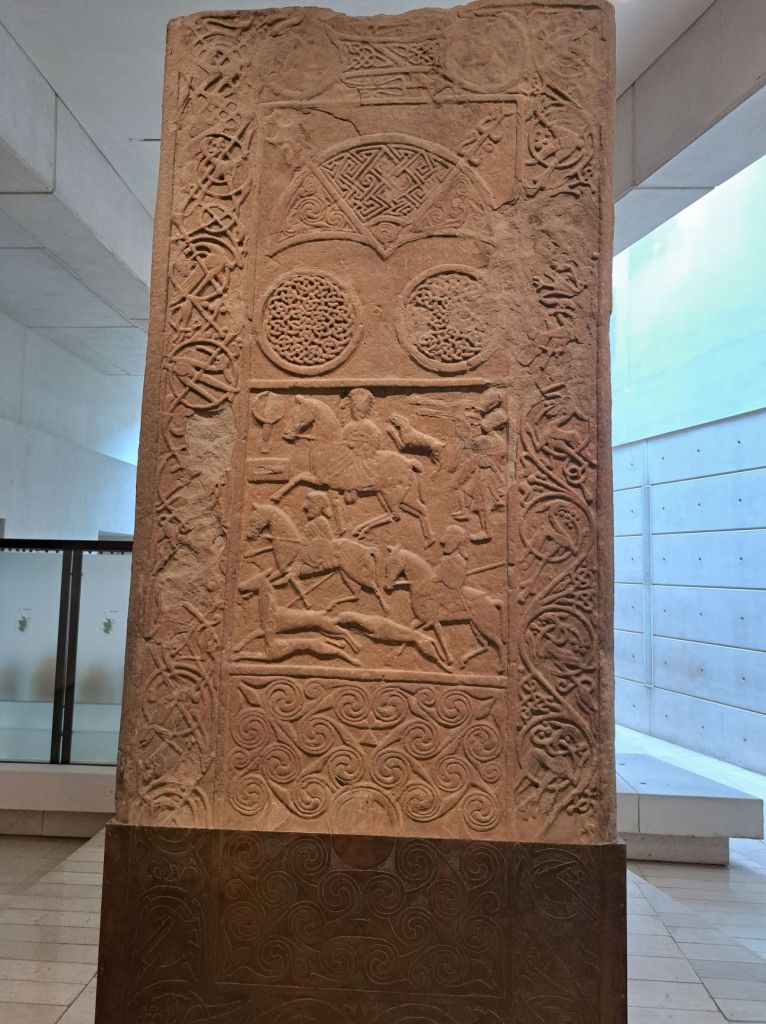
Her father had not been a young man at the time of the Battle of Dun Nechtain – probably in his late 50s and he lived a further 7 years, dying in 692. Like many kings (including Ecgfrith) Bridei was buried on the holy island of Iona. On his death, the kingship was taken by someone called Taran, son of Entifidich. However after four years he was expelled by another Bridei (or Bruide, etc) and he fled to Ireland. This Bridei was Derilei’s son, the outcome of a relationship between her and a certain Dargart, a member of the Dalriadan Cenel Comgaill ruling classes. Dargart had been killed in 686 but his relationship with Derilei lasted long enough for the couple to have two more sons. The second of these was Nechtan who also became king when his brother Bridei died in 706. Nechtan will feature more in Part II of this Pictish Civil War series. A third son was (possibly) Congal whose death (but not much else) is reported in 712[1].
Besides these three offspring from her relationship with Dargart, Derilei had at least one more son. The Annals report that in 713[2], Cinead, son of Derilei and (also) a son of Mathgeman were killed. The original text uses a mixture of Irish and Latin for the word “son” and the way it is written does suggest that Mathgeman is not the same person as Cinaed. (“Cinaedh mac Der Ili et filius Mathgernan iugulati sunt”).
This killing may be linked to Nechtan, now King, ordering the imprisonment of his brother Talorc in the same year. Talorc is described as the son of Drostan[3] and as a brother of Nechtan, his mother must have been Derilei. His captivity was temporary as later in the sources we find him being imprisoned again (in 734) and at his death (739) he is describes as “rex Athfoitle”, king of the Pictish sub-region Atholl[4].
The normal method in the sources of describing characters (usually men) as sons of other characters (also usually men) meant that it was once thought that Derilei was therefore a man. The kings Bridei and his brother Nechtan are described in the Annals and the Pictish king lists as “sons of Derilei” but it is other other sources lead us to the name of their father. These include “The Orygynale Cronykil of Scotland” by Andrew of Wyntoun[5] (late 14th century) and the Life of Saint Serf from the 13th century[6].
In summary then we can say that Derilei was the daughter of King Bridei, the victor of Dun Nechtain, and the granddaughter of Bili, King of the Strathclyde Britons (who incidentally is described elsewhere[7] as the maternal first cousin of Ecgfrith, the loser of Dun Nechtain).
Two of her sons with Dargart, the Dalriadan Scot, became kings of the Picts. First there was (another) Bridei who reigned from 697-706; then his brother Nechtan. Derilei and Dargart probably had another son together, Congal, who died in 712.
Derilei is explicitly stated to have been the mother also of Cinaed who was killed in 713 and she was probably the mother (with Drostan as father) of Talorc who was coincidentally imprisoned by his brother King Nechtan in the same year. Talorc may have had ambitions to be “overking” of the Picts – he will feature later in the aftermath of the coming Civil War, and he was certainly the sub-king of Pictish Atholl.
Nothing else, so far, has been found in the records for Derilei. It’s not much in total, but it is more than we usually hear of Pictish women.
[1] Annals of Ulster 712.4 “Congal m. Doirgarto moritur”. (Congal son of Dar Garto dies)
[2] Annals of Tigernach 713.5 “Cinaedh mac Der Ili et filius Mathgernan iugulati sunt” (Cinaedh son of Derili and the son of Mathgernan were (brutally) killed.) See also Annals of Ulster 713.4
[3] Annals of Ulster 713.7 “Tolargg filius Drostain ligatur apud fratrem suum Nectan regem”. (Tolarg son of Drostan is held captive by his brother, king Nechtan.)
[4] Annals of Ulster 739.7
[5] Ch XII, 5199-5200: “Brwde Dargardys sowne, in Scotland, Kyng oure the Peychtyis than regnand”
[6] Ch VI: “Rex autem Scocie… Brude filius Dargart, qui Pictorum tunc temporis regnum tenuit” (But then the King of Scotia, namely Bryde, son of Dargart, who then held the kingdom of the Picts”)
[7] Nennius, Historia Brittonum 57: “Echfrid ipse est qui fecit bellum contra fratruelem suum, qui erat rex Pictorum nomine Birdei” (Ecgfrith himself who made war on his cousin named Bridei, king of the Picts)


Leave a comment