
The Pictish Civil War Part II
As set out in the last post, the figure generally known as Nechtan became in 706 the second of Derilei’s sons to sit on the Pictish throne. Unlike his brother, Bridei, he is described in the sources as king of Picts (not Fortriu)[1].
The name Nechtan is the one used in the Gaelic sources. As seen last time, Nechtan’s heritage covered all of the main powers in the region. His mother Derilei was the daughter of the Pictish king Bridei and the granddaughter of the British king Bili (himself a first cousin of the Northumbrian Ecgfrith). His father was the Dal Riadan Scot, Dargart. He was very much a product of the interconnected cultures in early medieval times. However as a Pictish king, he would have been known as Naiton.
He is perhaps best remembered for the religious reforms he brought to Pictland. Bede (who also calls him Naiton) tells how he “renounced the error which so far he and his race had held about the observance of Easter and led himself and all his people to celebrate with him the catholic time of keeping Resurrection Sunday.[2]” He did this by seeking the help of Abbot Ceolfrith from the Abbey of Jarrow and Wearmouth. In reply, the Abbot sent a letter of advice to Naiton which is reproduced/reconstructed at length by Bede (who was a monk at the abbey) and which sets out the calculations to be used. The dating of Easter had previously caused some disagreement in Northumbria. Until 664, the Christian rulers of that kingdom, and their followers, had used the Celtic calculation (Northumbria had been very heavily influenced by the dominant religious centre at Iona) but had been coming under pressure from leaders to the south to adopt a newer “Roman” version. In that year the Synod of Whitby concluded that the newer version would be used. There were other differences between the two versions of Christianity which were ironed out at Whitby, including what type of hairstyle the monks should have.
In the early 8th century, the Picts continued to follow the Iona-based practices, and this is what Naiton was seeking to change. Whether this was linked to a desire by the Pictish king to make himself more amenable to the English is unclear. It may have simply been a very religious view from a very religious king.
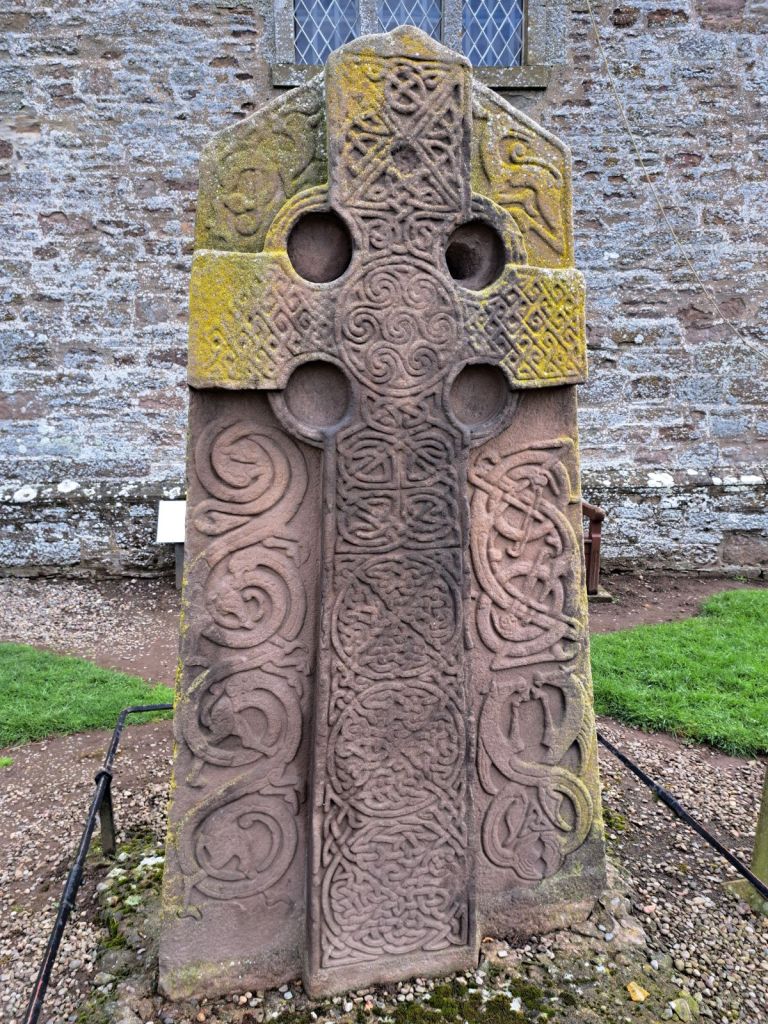
As well as the Easter date change (and the monks’ hairstyles), Naiton also asked the Northumbrians to send builders “to build in the Roman style a church of stone in their nation after the Roman fashion, promising that it should be dedicated in honour of the blessed chief of the apostles. He himself, with all his people, would always imitate the manner of the holy Roman and apostolic church, in so far as they had been able to learn this while being so far removed from the Roman language and nation.[3]” Any interpretation that up till this point the Picts had built their churches out of wood or some other material is probably wrong. Bede may have been referring to a particular type of stone construction (e.g. by using mortar).
The date of these changes is thought to have been around 710. Seven years later, Naiton went further by expelling the Ionan clergy beyond the “Dorsum Brittaniae”. This is a term for a mountain range which was often used in the sources and can no longer be located exactly. However, along with its Gaelic name Druim Alban it can generally be taken to mean a barrier where land to its west was not considered to be Pictish territory. Possibly it lay somewhere near the more recent border between Perthshire and Argyllshire/Invernesshire (or the even more recent council boundaries of Stirling/Perth & Kinross and Argyll& Bute and Highland).
Once Ceolfrith’s letter had been translated and read to Naiton, he was happy with the advice, giving instructions that all clerics in his kingdom must accept it. “Without delay, he enforced his word by royal authority,”[4] Bede tells us, with copies of the new dates sent out to “all the Pictish provinces[5]”. Bede is perhaps not a completely unbiased and reliable witness, noting that the “the nation rejoiced when it was corrected.[6]” However despite this alleged general acceptance, Naiton’s reign had not been immune from political struggles.
In 709 the Annals report a victory by someone over the Oracadians. Orkney was very much part of Pictland and this could have been an internal rebellion against Naiton. It is also possible that this was an attack by the Scots against the Picts (as had happened over a century earlier).
In 710, four years after he became king, two of his sons were killed as part of the internal battles of the Dal Riadan Cenél Comgaill (to which his Scottish father had belonged). A year later a Pictish force was slaughtered somewhere near modern-day Falkirk by the Northumbrians. Does this mean that any attempt by Naiton to curry favour with the Anglo-Saxon kingdom (if indeed that had been the intention of the religious changes) had failed? Or was this a defeat of another group of Picts (note Bede’s use of the plural in the passage above). In any event it suggests that not all was well in Pictland.
In 713, Naiton’s brother (or half-brother) Cinaed[7] was killed and immediately afterwards the King imprisoned Talorc, his other half-brother (son of Drostan and Derilie – see Derilei, Mother of Kings). Another brother of Naiton, Congal[8], had died the year before, although in circumstances unknown.
Meanwhile over in the west – across that Dorsum Brittaniae – it appears that the Dal Riadan Scots were having some issues of their own. Of the various sub-kingdoms, power was currently fluctuating between the leaders of Cenél Loairn and Cenél nGabráin. The Loairn king, Ainfcellach had been deposed by his brother Selbach in 698, perhaps after Ainfcellach had lost overall lordship over the Scots to Cenél nGabráin. Selbach did not give up his pursuit of power however and the records tell of a number of battles involving the Scots.
In 701 Selbach destroyed the Loairn royal centre of Dunollie, perhaps facing internal challenges. Three years later the Scots were defeated by the Strathclyde Britons (probably), just north of Dumbarton Rock in the valley of the River Leven, but in 711, just as the Picts were being “slaughtered” by the English, the Dal Riadan army turned the tables and defeated the Britons at the unidentified Lorg Ecclet.
712 saw the burning of Tarbert (Tairpert Boiter) and Selbach’s siege of Aberte (Dunaverty), both in Argyll – possibly Selbach turning his attention to his Cenél nGabráin rivals. In 714, Dunollie was rebuilt by Selbach, eleven years after he destroyed it, a display of his current authority in the region. Then in 717 there is reported a further defeat of the Britons by the Dal Riadan Scots.
In 719 Ainfcellach, the king who had been disposed two decades earlier was killed in a battle against his brother Selbach at a place identified as Finnglen. This is probably situated between Lochs Scamadale and na Speinge, south of modern-day Oban. If it appears that Selbach was now the dominant Scottish figure, he had one final rival to contend with. This was Dunchad Bec of Cenél nGabráin, who seems to have been Dal Riadan overlord. A sea-battle took place between the two also in 719, and Selbach was forced to retreat. Two years later however Dunchad died, leaving the way clear for Selbach to assume the kingship of Dal Riada and possibly the most powerful of the many leaders in what is now Scotland.
By the year 723 therefore, we have a situation where the Scots are united under a powerful and expansionist Selbach while the Picts also have an overking who was strong enough to achieve his religious reforms, although there had been some cracks appearing in Pictish unity which were set to get bigger.
Then, having fought for so long and so hard to get to where he was, Selbach abdicated and entered the clerical life: “Clericatus Selbaich” say the Annals of Ulster (723.4).
This was not as unusual as it may seem. The practice could mean entry into monastic life, but in other cases it led to pilgramages to Rome. Bede notes that “at this time many of the English race – nobles and common people, layfolk and clergy, men and women – competed with each other to do the same thing.”.[9]
Not everyone approved of women joining the trips. The Benedictine English monk, Boniface (later St. Boniface) was one of those who did not. Writing in his letter to Archbishop Cuthbert of Canterbury in 747, he requests that Cuthbert forbids “matrons and veiled women to make these frequent journeys back and forth to Rome. A great part of them perish and few keep their virtue. There are very few towns in Lombardy or Frankland or Gaul where there is not a courtesan or a harlot of English stock. It is a scandal and a disgrace to your whole church.[10]”
Setting such misogyny aside, Bede elsewhere tells of a number of Anglo-Saxon kings who abdicated in favour of a religious path (Coenred of Mercia, Caedwalla of Wessex and his successor Ine[11]) but now it seems that the practice was taking hold further north.
In the following year, 724, Naiton did the same: “Clericatus Neactain reigis Pictorum” (“The entry of Nectan, King of the Picts, into clerical life”, Annals of Tigernach, 724.2).
Was this a truly religious act, in line with the trends going on elsewhere in Britain or were there other factors that led to his decision. To use a cliché, did he jump or was he pushed? The next post will cover both what may have led to Naiton’s abdication and what happened after it.
[1] “ro gab Nechtain mac Der Ili ríghi na Picardach” (Annals of Tigernach 728.5: “Nechtain son of Derile took the kingship of the Picts”; “…Neactain reigis Pictorum” (Annals of Tigernach 724.2: “…of Nectain, king of the Picts”)
[2] “abrenuntiauit errori, quo eatenus in obseruatione paschae cum sua gente tenebatur, et se suosque omnes ad catholicum dominicae resurrectionis tempus celebrandum perduxit” Bede V.21
[3] “ui iuxta morem Romanorum ecclesiam de lapide in gente ipsius facerent, promittens hanc in honorem beati apostolorum principis dedicandam; se quoque ipsum cum suis omnibus morem sanctae Romanae et apostolicae ecclesiae semper imitaturum, in quantum dumtaxat tam longe a Romanorum loquella et natione segregati hunc ediscere potuissent.” Bede V.21
[4] “Nec mora, quae dixerat regia auctoritate perfecit” Bede V.21
[5] “per uniuersas Pictorum prouincias” Bede V.21. Note the use of the plural.
[6] “gens correcta gaudebat.” Bede V.21
[7] He was also a son of Derilei
[8] Son of Dargart
[9] “Quod his temporibus plures de gente Anglorum, nobiles ignobiles, la ci clerici, uiri ac feminae certatim facere consuerunt.” Bede Ecclesiastical History V.7
[10] See https://archive.org/details/lettersofsaintbo00boni_0/page/140/mode/2up for a translation. I was not able to find the original text
[11] Bede, Ecclesiastical History V. 7 and 24


Leave a comment