
While this blog tries as best as it can, using historical references and other evidence to make sense of what was happening in the period that it covers, from time to time we will come across stories that are more legend or myth than fact. This post will be one of those as it relates what little we know about the Pictish king, Onuist II, but shamelessly enhances that content with one of the more remarkable legends of Scottish history. In doing so I will consider some of the later medieval sources for the period.
That Onuist II existed is not in doubt. The brother of Constantine who ruled 789-820, little is said about him in the sources other than that he appears to have ruled the Picts while his nephew, Domnall, son of Constantine, held some degree of authority over Dal Riada. Onuist’s death is reported in 834[1] and he was succeeded by another of his nephews, Drest (sometimes referred to as Drest IX).
Other than that, we have nothing…. except the legend of the cross and what became the flag of Scotland.
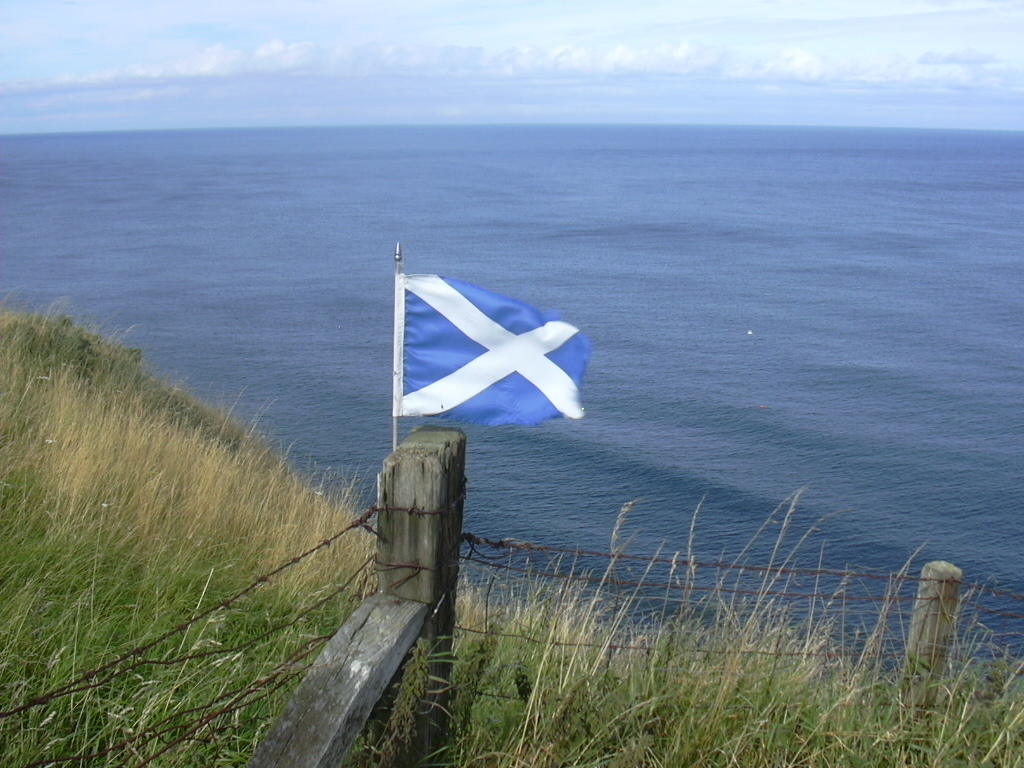
One of the earliest mentions of this episode can be found in version A of the St Andrews Foundation Legend[2]. This relates how a king of the Picts called Ungus, son of Urguist, had been terrorising the peoples of Britain and had made his way as far south as Mercia. Facing ambush by “all the peoples of nearly the whole island,”[3] Ungus had a divine vision. It was St Andrew, presenting the Pictish king with an image of the cross which would stand in the sky and help him against his enemies as long as he gave a tenth part of his inheritance in alms to Almighty God and in honour of St Andrew. In the battle which followed, the image of the cross was seen in front of the Pictish army, shining with a divine light, and Onuist/Ungus was the victor.
This text dates back to the first decade of the 12th century, some 250 years after the event and of course must be treated with caution. In an earlier post, I noted the links between St Andrew (or at least his church in the town in Fife which takes his name) and (probably) the earlier Pictish king, Onuist I, who died in 761, so there may be some mixing up going on here. There is no other evidence that either of the two Onuists faced an enemy made up of the rest of the island, or even that they went as far south as Mercia to raid. Nevertheless the legend is repeated through history, and new aspects are continuously added to the tale.
The slightly later St Andrews Foundation Legend version B (from the middle of the 12th century)[4] tells us that the battle took place near the mouth of the river Tyne and Onuist (here also called Hungus) faced the king of the Saxons, Athelstan. Again St Andrew appeared to the Pictish king the night before battle, promising to ensure victory. In return, the apostle expected his saintly remains to be looked after and honoured by the Picts “until the last day of time[5].” This time, more gore is added to the story. The defeated Athelstan was decapitated and his head was fixed on a wooden stake in the harbour of what became Queensferry, where the Forth bridges now connect Fife to Edinburgh.
The Tyne mentioned here is unlikely to be the one that runs through Newcastle and Northumbria. Instead it will be a different river of that name which rises in the Moorfoot Hills in East Lothian and travels through a number of towns, including Haddington, before meeting the sea after 30 miles. Also worth noting that in this version there is no cross.
However, later retellings bring the cross back. The next source to look at comes from John of Fordun[6], who wrote what may be the earliest continuous history of Scotland before his death in around the year 1384. His Chronicle includes the battle between Hungus and Athelstan, and he tells us that this Athelstan was the son of Æthelwulf and that he ruled “all the countries of the English-born nation, except the kingdom of Wessex” which Æthelwulf retained. This additional information presents us with a problem. It seems to be referring to Æthelwulf, who was also the father of Alfred (the Great), and who became king of Wessex in 839, some five years after the death of Onuist. Some versions of the Anglo-Saxon Chronicle state that Æthelwulf and Athelstan were brothers, which would at least help with the timing, but not the timing of the supposed regal delegation. We will come back to this problem.
The next source to consider is Walter Bower’s Scotichronicon, a continuation of Fordun’s work which was written in the first half of the 15th century. In this account Bower gives us a little more information about the geography telling us how Hungus, king of the Picts, stopped “at a pleasant plain in Lothian not far from the river Tyne, two miles from Haddington, at a place which is now called Athelstaneford.[7]” Again he is told that “an angel bearing the standard of our Lord’s cross will go in front of you in sight of many” to ensure his victory, which also ends with Athelstan’s head being chopped off and displayed on the island of Inchgarvie, near to Queensferry. The macabre sight remained there for many years “to be seen by all those who made the crossing throughout several years.[8]”
In 1527, Hector Boece’s History and Chronicles of Scotland was published in Latin and translated into Scots by John Bellenden in the following decade. This latter version adds the information that Angus sent ambassadors to his brother-in-law, King Achaius, who is described as a King of Scotland. You can see a picture of him from the National Gallery of Scotland here. Whilst the timing fits well with Onuist II, the doubt about his existence (he is not mentioned in the chronicles), does not help.
Achaius who?
In my article Kings in the North, I noted that the history of kingship in Dal Riada in the last decades of the 8th century is far from clear. After the death of King Fergus in 781, “we hear of a king called Donncoirce who lasted until 792. One source does mention that Fergus was succeeded by his son Seluand, but of this person there is no further information. There is then a gap between Donncoirce and the next recorded king around the year 805 who is Conall, son of Tadg…. One source does list a certain Domhnall who, “no imbecile”, reigned for 24 years, but it is likely that this king came later – and he will be discussed in a future post. By the year 790 therefore we have Constantine in charge of the Picts but remain unsure what was happening in Dal Riada.”
Into this mess it seems we must also insert Achaius. According to Boece, this Achaius was the son of Ethfine, and he became king following the death of his predecessor in that role, Solvathius[9]. After making peace with the Irish, he then also concluded a treaty with Charlemagne, who became the Carolingian Emperor in the year 800.
There are other references to this king in later works too.
George Buchanan published his “Rerum Scoticarum Historia” in 1582 and appears to have leaned heavily on Boece[10]. His work included a list of Scottish kings dating back to the legendary Fergus in the 4th century and a selection follows:
- Eugenius VII (reigned from 699)
- Mordacus (716)
- Etfinus (731)
- Eugenius (761)
- Fergus III (764)
- Solvathius (767)
- Achaius (787)
- Congallus (819)
- Dongallus (824)
Very little of this makes sense when compared with the lists set out in previous posts such as Nechtan mac Derilei: King Naiton of the Picts and Kings in the North which suggest the following rulers in Dal Riada:
- Selbach (from 698, after deposing his brother Ainfcellach)
- Dungal, son of Selbach (723)
- Eochaid mac Eachach (726)
- (possibly) Muireadhach, son of Ainfcellach (733)
- Years of Pictish ascendancy (mid 730s-760)
- Aed Find (761)
- Fergus (778)
- Donncoirce (781)
- The two Conalls (805)
- Domnall, son of the Pictish king Constantine (from 811)
There are some similarities here (Congallus and the two Conalls, Dongallus and Domnall) but no great clarity.
Finally, David Hume of Godscroft (not to be confused with the 18th century philosopher of the same name) published his “History of the House and Race of Douglas and Angus” in 1644[11]. In this he also tells of Achaius and his treaty with Charlemagne, implying that this was the start of the long alliance between Scotland and France. Hume also asserts that Achaius succeeded Solvathius.
Could it be that Solvathius and Achaius are somehow versions of Selbach and Eochaid mac Eachach? These two kings seem to be mentioned consecutive in the 11th century Synchronisms of Flann Mainistreach[12] and follow a certain “Eocho Rianamhail, son of Aed Find.”
- Selbach mac Ferchair, and
- Eochaig Angaid a meadon flaith (“to the middle of his reign”)
I suspect we will never get to the bottom of this: the name of Achaius has come from somewhere, and whether he existed or not, he has become part of the Hungus/Onuist v Athelstan story, so let’s return to that.
Back to the Legend
Boece tells us that Achaius answered the call from the Picts and sent troops to help. The Picts “had set down their tentis beside ane burne, nocht two milis fra Haddingtoun”[13] (had made camp beside a stream just two miles from Haddington.) This time, as battle commenced, the morning after St Andrew had responded to the Picts’ prayers and appeared in a dream to Hungus:
“It is said, that ane schinand croce was sene in the lift, straucht above the army of Pichtis, not onlik to the samin croce that the apostil deit on. This croce vanist nevir out of the lift quhil the victory succedit to Pichtis[14]”
(It is said that a shining cross was seen in the sky, right above the Pictish army, not unlike the same cross that the Apostle died on. This cross did not disappear from the sky until the Picts had secured victory)
For the first time we hear that this cross is the St. Andrew’s cross – the Saltire.
Further references can be found in later works. William Camden’s Britannia (early 1600s) states that:
“A little way from Hadington, stands Athelstaneford, so named from Athelstan, an English Commander who was slain there with his men about the year 815.”[15]
Camden goes on to make it clear that this cannot be King Athelstan of Wessex (the grandson of Alfred and therefore the great-nephew of the Athelstan, son of Æthelwulf mentioned above) because of the timings, and it is interesting that he calls him a Commander, not a King.
John Spottiswoode writes in his 1655 (posthumously published) “History of the Church and State of Scotland”[16] that King Achaius helped Hungus – as above – and repeats the claim that a village took it’s name from the nearby ford and from Athelstane, King of Wessex.
Finally, turning to the Old Statistical Account of Scotland[17] “Athelstaneford, County of Haddington, OSA, Vol. X, 1794”, we get the added confusion that Athelstan may have been a Dane. Again we get the cross in the sky, the support of 10,000 men sent by Achaius King of the Scots, and the victory of Hungus.
So, setting aside the vision of the cross, is any of the rest true? It is possible that someone called Athelstan did exist and did lead a Northumbrian army (which at that time may have included Scandinavian as well as Anglo-Saxon influences) against Onuist in the early 8th century and that a myth has grown up the outcome of the battle. We can certainly rule out the possibility that any battle took place between Onuist and the later Athelstan (who ruled in the 10th century). It could just about be possible that Athelstan, son of Æthelwulf, was involved somehow, but I suspect he was too well-connected a figure for his death and display of his head not to be reported elsewhere.
It is also worth noting that the story is reminiscent of one which relates to another Constantine – not Onuist’ s brother and predecessor as king, but the Roman Emperor. On the eve of battle in 312, against one of his rivals, Maxentius, at a place called the Milvian Bridge (on the river Tiber), Constantine had a vision of a large cross of fire in the sky, with accompanying writing which said “By this sign, you will conquer.” Constantine had been considering converting to Christianity and this convinced him to do so, which he did just before his subsequent victory.
The tale also has similarities with the Anglo-Saxon Oswald, a Christian prince who had been converted while in exile in Dal Riada. In 633-4 he faced an alliance between the Christian Cadwallon of Gwynedd and Pagan King Penda of Mercia who had invaded Northumbria and had taken power away from the Northumbrian nobility. At a place called Hefenfelth (or Heavenfield), next to Hadrian’s Wall, a decisive battle took place between Oswald and Cadwallon. The night before the battle, St Columba (see also Iona and the Vikings ) appeared to the Northumbria prince and promised him victory. Oswald raised a cross in honour of the Saint, and victory was assured.
The Flag of Scotland
Whatever the level of veracity in the legend of Hungus/Onuist and the cross, it has not stopped the village of Athelstaneford (some 20 miles east of Edinburgh) from declaring itself to be the birthplace of the Scottish flag. An exhibition commemorating the legend can be found in a restored dovecot which stands just behind the parish church. Further details can be found at The Flag Heritage Centre – The Scottish Flag Trust.
In terms of what we do know about Onuist, as stated above, he died in 834, and his nephew Domnall seems to have held sway over Dal Raida for one more year until he passed away in 835, but I will pick up next time what was happening in the royal houses in the 830s and also return to some of the earlier sources.
[1] “Oengus m. Fergusa, rex Fortrenn, moritur.” (Aengus son of Fergus, king of Fortriu, dies) – Annals of Ulster 834.1
[2] For the original Latin see “Chronicles of the Picts, Chronicles of the Scots, and Other Early Memorials of Scottish History” by William Forbes Skene, pages 138-140
[3] Skene, page 139: “omnes pene totius insule gentes”
[4] Skene, pages 183-193
[5] Skene, page 184: “in ultimum diem”
[6] I have used a translation of Fordun’s Chronicle by Felix Skene (edited by Willam Skene) – available via print-on-demand and also via this link: John of Fordun’s Chronicle of the Scottish Nation
[7] D.E.R Watt (ed): “A History Book for Scots: Selections from Scotichronicon, by Walter Bower” (2012), page 38
[8] Ibid page 39
[9] The History and Chronicles of Scotland by Walter Bocce, translated by John Bellenden, Volume II, Book 10, Chapter 1 – available here
[11] Available here: https://archive.org/details/historyhouseand00humegoog/page/n37/mode/2up
[12] Quoted in “Chronicles of the Picts, Chronicles of the Scots, and Other Early Memorials of Scottish History” by William Forbes Skene, page 20
[13] The History and Chronicles of Scotland by Hector Boece, translated by John Bellenden, Volume II, Book 10, Chapter 5 – available here
[14] Ibid
[15] Available online at https://archive.org/details/gri_britanniaora02camd/page/n321/mode/2up
[17] Available online at https://stataccscot.ed.ac.uk/static/statacc/dist/viewer/osa-vol10-Parish_record_for_Athelstaneford_in_the_county_of_Haddington_in_volume_10_of_account_1/

 The Northern Tapestry
Leave a comment