
The narrative of history occasionally tells of battles whose outcome can justifiably claim to have determined the future. One such battle took place on 20 May 685 somewhere in what is now Scotland, between the Northumbrian English, led by their king Ecgfrith (Ecgfrið), and the Picts, led by Bridei, son of Beli. It is usually known by either its Scottish name Dun Nechtain or the Anglo-Saxon Nechtansmere. We don’t know what it’s Pictish name would have been, perhaps something like Lin Garan (see below).
Background to the Battle
During the second half of the 7th century, the Anglo-Saxons controlled much of what is now lowland Scotland. Ecgfrith had ruled a joint Northumbria since 670 (he had previously been in charge of the southern sub-kingdom of Deira since 664). The Picts – as well as the Strathclyde Britons and the Dal Riadan Scots – had been playing second, third and fourth fiddle to the English for decades. Unsurprisingly, they were not content with this status, as can be seen by the Pictish rebellion of 671 which was crushed at the so-called Battle of the Two Rivers (possibly somewhere in modern Perthshire).
By the 680s, the English church had also begun to take hold in Pictland. In his “Ecclesiastical History of the English People”, Bede notes that in 681, The Archbishop of Canterbury appointed Trumwine, a contemporary of Cuthbert (later Saint Cuthbert), to the “Province of the Picts, which at that time was subject to English rule.” The original Latin uses terminology which very much echoes that which describes the governance of the Roman Empire (“prouinciam Pictorum, quae tunc temporis Anglorum erat imperio subiecta.” Bede, IV.12). Trumwine took up residency at Abercorn on the Firth of Forth.
The Battle
For reasons not entirely apparent (and certainly against the advice of people like Cuthbert), Ecgfrith decided to march north in May of 685 to take on the Picts. The battle is mentioned in several sources.
In the Annals of Tigernach 686.4 we read: “The battle of Dún Nechtain happened on the Sabbath day 20th May, in which Ecgfrith, son of Oswiu, king of the Saxons, with fifteenth years of his rule completed, was killed, along with a large company of his soldiers by Bruide son of Bile, king of Fortriu.
(Cath Duín Nechtain uicesimo die mensis Maii, sabbati die factum est, in quo Ecfrith mac Osu, rex Saxonum, quinto decimo anno reighní suí consummato, magna cum caterua militum suorum interfectus est la Bruidhi mac Bili regis Fortrenn.)
An almost identical account is seen in the Annals of Ulster 686.1, although Bruide is not named:
“The battle of Dún Nechtain was fought on the Sabbath day, May 20th, and Egfrid son of Oswy, king of the Saxons, who had completed the 15th year of his reign, was killed along with a large company of his soldiers.”
(Bellum Duin Nechtain uicisimo die mensis Maii, Sabbati die, factum est, in quo Etfrith m. Ossu, rex Saxonum, .x.u. anno regni sui consummata magna cum caterua militum suorum interfectus est)
The Annals of Innisfallen (685.1) slightly confusingly record a “great battle among the Picts” (Cath mór eter Cruithnechu”) Note how the original old Gaelic/Irish uses the adjective Cruithnecu to describe the Picts. The differing terms used for the people of the northern British Isles certainly deserves more investigation and I hope to write about that in the near future.
It is from the Welsh monk and historian Nennius that we get the old British name of the battle: “Ecgfrith himself who made war on his cousin Brudei, king of the Picts, and there he fell with all the strength of his army and the Picts with their king gained the victory; and the Saxons never again exacted tribute from the Picts. From the time of that war it is known as the Battle of Lin Garan.” (Echfrid ipse est qui fecit bellum contra fratruelem suum, qui erat rex Pictorum nomine Birdei et ibi corruit cum omni robore exercitus sui et Picti cum rege suo victores extiterunt et numquam addiderunt Saxones ambronum ut a Pictis vectigal exigerunt. a tempore istius belli vocature Gueith Lin Garan. – Historia Brittonum 57).
Lin Garan means “pool of the heron” and this may be what the Picts, with their language probably most similar to old British/Welsh, came to call it
The English name for the battle comes from Symeon of Durham’s early 12th century “History of the Church of Durham”, chapter IX: “King Ecgfrith… was killed, along with a large part of his army which he had taken with him to lay waste the land of the Picts at Nechtanesmere, that is the lake of Nechtan”
(At rex Egfridus, … cum maxima parte copiarum quas ad devastandam term Pictorum secum duxerat … extinctus est apud Nechtanesmere, quod est stagnum Nechtani.)
The Anglo-Saxon Chronicle also records the death of Ecgfrith near the “northern sea” (be norðan sæ) on 20th May 685.
It is Bede (VI. 24) however who provides most detail about the Battle. Confronted by the invading English army, the Picts, he says, pretended to retreat and lured the king into some narrow passes “in amongst inaccessible mountains” (in angustias inaccessorum montium). Ecgfrith was killed with the largest part of his army, so paying the price for the sin of not heeding the advice of those who wanted to save him from destruction (ex poena peccati illius, ne nunc eos, qui ipsum ab interitu reuocare cupiebant).
Traditionally the Battle has been located around Dunnichen, near Forfar. The Irish and British sources suggest that it was at or near a fort (Dun) or pool/lake (Lin), with the water feature also appearing in the English name (Mere).
The revised view in recent years, first put forward by Alex Woolf in 2006[1], regarding the territory of Fortriu and placing its location further north than the hitherto held understanding that it was somewhere around Perthshire/Angus, has led to questions about the location of the battle. Bede’s description of “narrow passes in inaccessible mountains” would suggest the landscape of the highlands rather than Forfar. However we should remember that Bede was not an eye witness and as an Anglo-Saxon, he may have been keen to suggest a terrain which helped to excuse or explain the defeat (although he is clearly no supporter of Ecgfrith).
The Dunnichen site near Forfar is beside a number of bodies of water which could be classed as a lake: among them, both Roscobie and Restenneth lochs are (or were) close, the latter having been reduced in size over the centuries as a result of drainage. There are surrounding hills too.
Another candidate is Dunachton in Badenoch, some 60 miles north west of Dunnichen, across the Cairngorm Mountains.
Although Woolf’s repositioning of Fortriu northwards now seems unassailable, James Fraser argues[2] that the location of the battle being Dunnichen is a “distinct argument – its acceptance or rejection has no great bearing on the matter of Fortriu’s location.” Also if Bridei was likely to be found fighting anywhere in the 680s, it was in the southern Pictish zone[3].
This case is also made by Tim Clarkson[4] who argues that Dunachton may have been too far north to have been a viable objective of Ecgfrith’s campaign.
The mystery of the battle’s location will perhaps never been solved but there is one other factor which may help you decide whether you lean north or south. This is the question of the stones.
Pictish monuments have been found close to both possible sites. From Dunnachton we have a Class I stone, which had been recycled into a farm building, but now stands on its own. Although much of its detail is missing, a deer (or other beast)’s head can be seen clearly on one side.
The “southern” stone, known as Aberlemno II, is much more intriguing. It can be found a few miles north in the churchyard of the village which bears its name. This is a Class II stone, with a cross and Celtic designs on one side. On the other side a battle is depicted alongside Pictish symbols. The stone was almost certainly carved in the decades after 685, but could it be a memorial to the clash with Ecgfrith?
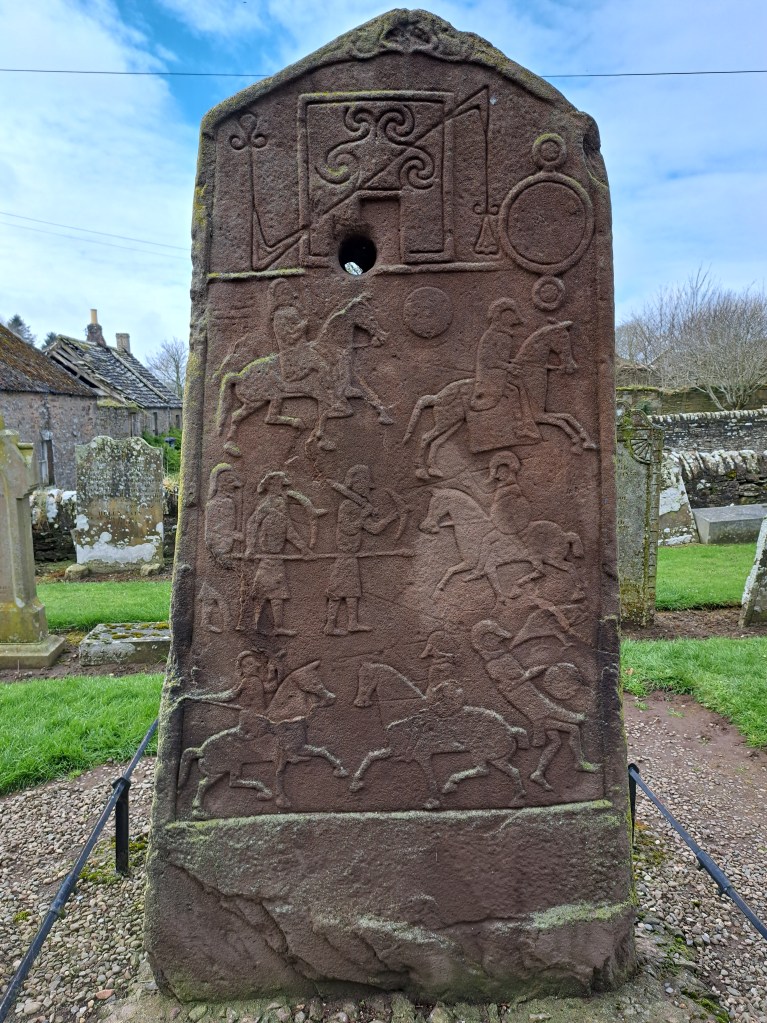
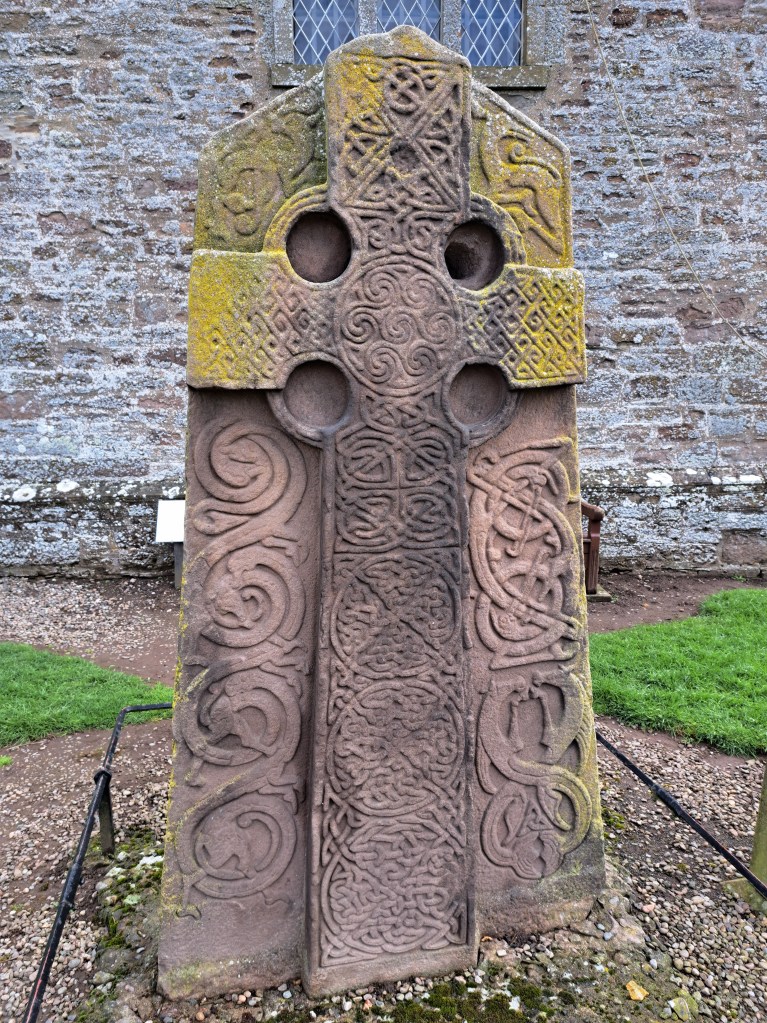
(Incidentally, there was also a Type I stone found at Dunnichen itself. This does not have a battle scene!)
Aftermath and Legacy
Whatever its location, the battle was certainly important and led to the decline of Northumbrian power in southern Scotland. Trumwine was forced to flee to Whitby and many English settlers who did not manage to escape were either killed or forced into slavery.
Bede notes that the hopes (spes) and strength (virtus) of the English began to ebb and flow away (fluere ac retro sublapsa). Again, Bede uses the language of the Romans, this time quoting the poet Virgil who in his epic poem, The Aeneid, describing the hopes of the Greeks fading away uses those exact words: (fluere ac retro sublapsa; Aenied II.169).
One final reference from Bede worth noting is where he is describing the fleeing English after the battle. While these people are desperately trying to escape with their lives or freedom, Bede clearly states that they are fleeing “de terra Pictorum”, the land of the Picts. Bede therefore is describing the Northumbrians as occupiers now being forced out of Pictish territory.
The impact on Northumbria should not however be exaggerated. Its authority in Pictland (and by extension the rest of what is now Scotland) had been checked, but that kingdom would remain a political (and cultural) power for many decades to come.
As for the Picts, the victory and expulsion meant they no longer had to pay tribute to the English. This gave them space to develop their economy and strengthen, building a realm which would not only be attractive to control (as can be seen in the forthcoming civil wars), but also lead to their dominance of northern Britain in the next century.
[1] Alex Woolf: “Dun Nechtain, Fortriu and the Geography of the Picts”
[2] James E Fraser: “From Caledonia to Pictland. Scotland to 795” p 215
[3] Ibid p216
[4] Tim Clarkson: “The Picts” p 129


Leave a comment