
Although there is little evidence of it today, the tiny village of Forteviot with its population of around 200 was once the centre of the Pictish and newly-emerging Scottish kingdoms in the 9th century. Around 15 miles south-west of Perth, and situated in the Strathearn valley, close to the River Earn, we first heard of this place back in Constantin, son of Uurguist/son of Fergus where I wrote about the magnificent Dupplin Cross. This beautiful carved stone can now be found a few miles away within St Serf’s Church in Dunning but it was originally set out in the open near the royal Pictish lands of Forteviot.
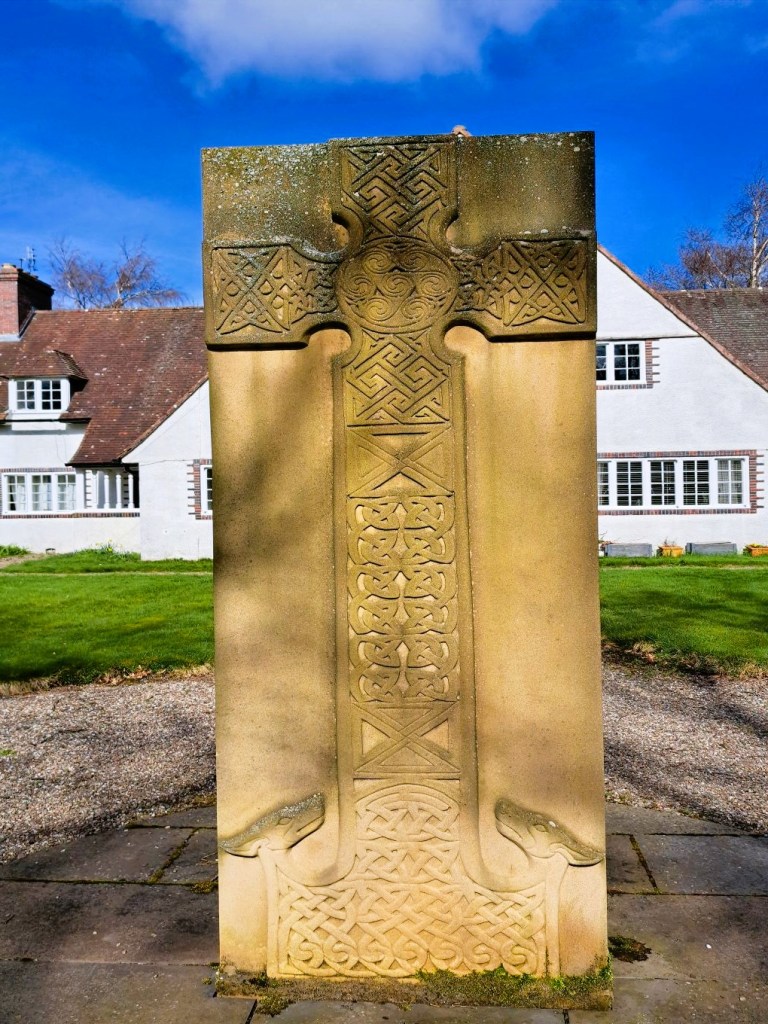
The name cropped up again in the three posts which feature Kenneth MacAlpin:
- The Last Pictish Kings: Part 2 – Kenneth, Brude, Drust… and Kenneth
- Kenneth MacAlpin Part II
- Kenneth MacAlpin Part III – a modern interpretation
According to Version A of the Pictish King Lists (The Poppleton Manuscript), Kenneth “died of a tumour, before the Ides of February on the third day of the week (Tuesday 13th) in the palace of Forteviot.”[1] This was in 858[2].
As we saw in those posts, Kenneth has become a major character in early medieval Scottish history, linked with the final joining together of the Picts and Scots of Dal Riada, and he was succeeded by his brother Domnall – or Donald. Unfortunately the details we have of Domnall’s reign are very scant indeed, and even Nigel Tranter would struggle to weave a novel from them, as he did with his predecessor.[3]
The Annals simply tell us that in 862, “Domnall m. Ailpin, rex Pictorum, mortuus est[4].” (Donald, son of Alpin, King of the Picts, died). Note that he is referred to as king of the Picts, suggesting that if Kenneth had indeed merged the two kingdoms into one, the annalists were unaware of it, at least at that stage.
Turning again to the (albeit later) Scottish sources, version A of the Pictish Chronicle (Chronicle of the Kings of Alba) states that after the death of Kenneth:
Dunevaldus, frater eius, tenuit idem regnum iiii. annis. In hujus tempore, jura ac leges regni Edi filii Ecdach fecerunt Goedeli cum rege suo in Fothiurthabaicth. Obiit in palacio Cinn Belachoir idus Aprilis[5].
(Donald, his brother, held the same kingdom for 4 years. In his time, the Gaels established the rights and laws of the kingdom of Áed the son of Eochaid, with their own king at Forteviot. He died in the palace of Cinn Belachior on the Ides of April.)
Meanwhile, version D of the Chronicles[6] says:
“Douenald mac Alpin iiij. annis regnavit et mortuus est in Rathinveramon et sepultus in lona insula.”
“Donald son of Alpin reigned for four years and died at Rathinveramon and was buried on the island of Iona.”
The 13th century Cronicon Elegiacum (13th century)[7] Quoted in Skene here page 177:
“Rex Dovenaldus ei successit quatuor annis
In bello miles strenuus ille fuit
Regis predicti frater fuit ille Kyneti
Qui Scone fertur subditus esse neci”
(King Donald succeeded him for four years
In war he was a vigorous soldier
He was the brother of Kenneth, the king previously mentioned
And he is said to have been assassinated at Scone)
The final source we have is much more dubious. This is the Prophecy of St Berchan, which although written no earlier than the 12th century, and possibly later, pretends to be a prophecy delivered in the 5th century which “predicts” the lives of a number of Scottish kings – without actually naming them – from Kenneth to Domnall Bán (who died in 1097). Thus it’s a kind of history in which the reader has to guess (through their historical knowledge) who the prophet is talking about in any particular stanza. Nevertheless, that does mean that it should contain some accepted facts (otherwise it would be a pretty poor prophecy!). After telling us of a King who reigned for seventeen years and who slaughtered the Picts[8], annoyed the Foreigners and died on the banks of the Earn (i.e. Forteviot) – meaning of course Kenneth, we have this rather disparaging account of Domnall:
An mear mhac na Gaillsighthe.
Tri bliadhna do ua Ri,
Ocus tri mis, cia rimhi.
Os Loch Adhbha bhias a leacht,
Adbail do galar ainfhecht .
(The wanton son of the foreign wife
Three years of this king
And three months, whoever is counting;
On Loch Adhbha will be his grave
Dying of a terrible disease)
So, what can we make of all this?
Putting most trust in the Annals, due to their more favourable proximity to the events, and less likely to suffer from any “Scottish” bias, whether that be Pictish, Scottish or anything else, we can say that when Kenneth died in 858, he was succeeded by his brother Domnall, who reigned until 862. Kenneth died in February 858, so the “with hindsight prophecy” of Berchan of three years and three months would only make sense if Domnall’s succession was somehow delayed until very late in 858. I suspect it is more likely that the author of the prophecy, writing some centuries later, had an uncertain timeline.
The prophecy is – as above – quite rude about the king, but none of this is repeated in other sources. The nationality of his mother is not mentioned elsewhere. His peaceful death (albeit from a terrible disease) in the prophecy is contradicted by the Cronicon (assassinated) and his place of death and burial are variously referred to as:
- Assassinated at Scone (Cronicon Elegiacum)
- Died at the “palace” of Cinn Belachoir, buried on Iona (Chronicles of the Kings – Version A)
- Died at Rathinveramon (possibly just north of modern Perth, therefore close to, if not actually, Scone) (Chronicle of the Kings – Version D)
- Unsure where died, but buried on Loch Adhbha (Prophecy of St Berchan)
Where then are these places Rathinveramon and Cinn Belachoir? Fiona Campbell-Howes has written a fascinating blog, Rossia, Rigmonath, Bellethor: Early Gaelic settlements in Pictland?, working through the possibilities, including that both were somewhat west of Perth (at the foot of Loch Tay). In the end, she accepts the likelihood that Rathinveramon was in fact the meeting of the rivers Almond and Tay Perth (opposite Scone[9]), although the site of Cinn Belachir remains uncertain.
Regarding Loch Adhbha as a potential place of burial, again we have little to go on. Skene suggested that the name meant “loch of the palace[10]” while Fiona Campbell-Howes notes that the Old Irish translation of Adhbha is “dwelling-place.” Others have suggested Loch Awe (around 20 miles east of Oban). While the location remains a mystery (although I would strongly urge you to read Fiona’s blog which covers much more than my brief references here allude to), we should also look at the other notable comment relating to Domnall, quoted above in Version A of the Chronicles, i.e. that “In his (Domnall’s) time, the Gaels established the rights and laws of the kingdom of Áed the son of Eochaid, with their own king at Forteviot.” The reason for the trip is unclear: were the Gaels asking for permission to continue to use – or re-establish – some laws and customs from a century earlier?
Áed the son of Eochaid, is most likely to be Áed Find, whom we met in Kings in the North as a Dál Riadan king who managed to re-establish some independence from the Picts after the death of Onuist I in 761. Aed died in 778.
The text here seems to suggest that the Gaels came to Forteviot with their own king (“cum rege suo”) i.e. someone other than Domnall, who had been described in the Annals as “rex Pictorum”. So, at the very least, it looks like the two peoples were not yet fully united. Perhaps, as Alex Woolf suggests[11], this indicates that a sort of devolution arrangement was in place and the meeting was an opportunity where oaths were being taken to preserve good relations between the two. On the other hand, could it mean that despite the use of the title “king of the Picts” by the Irish annalists, in Scotland Domnall was indeed seen as a Gael himself and he was now imposing those ancient customs and laws on Pictland? I suspect this may be imposing views backward onto the history and the first explanation is probably the more realistic. It is always a risk that when sources are scarce we place too much emphasis on individual words or phrases and can come up with (as above) quite different interpretations or extrapolate more meaning than the original reference deserves. (It reminds me of, and is similar to, a sort of historian’s synecdoche, where a single reference will become extended over a wider group; an example of this is the word “Brittunculi” found on one of the Vindolanda Tablets near Hadrian’s Wall. Here one word in a letter complaining about the native population has led to the wide-sweeping view of some that this was the general view of the Britons by all Romans.)
In addition to Kenneth’s death, we have come across Forteviot before. Drust, son of Ferat, the last Pictish king before Kenneth MacAlpin, was possibly murdered there in 848[12].
In the St Andrew’s Legend B, dating from the middle of the 12th century, Forteviot is mentioned as being a Pictish power centre in the days of Onuist II (King of Picts 820-834) and where he is said to have left his three sons in safety when going into battle with the Gaels of Argyle and ordering that a tenth of the “city of Forteviot” (decimam partem de urbe Fortevieth) be given to God and St Andrew [13]. Later on he also built a basilica there in honour of God and the Apostle (Andrew).[14]
We have to be cautious with modern translations of the words used alongside Forteviot such as urbs (city) or “palacio”[15] (palace). These are obviously not of the same magnitude of place like Rome, which would also have these words associated with it. However, it is clear that Forteviot was a major centre of Pictish power, as seen by its relationship with the kings mentioned above and the summit with the Gaelic king (if that is what this was). Perhaps this was due to its location, although normally Pictish strongholds were on hills rather than in low-lying river valley; but it has also been suggested that the landscape held some ancestral authority. Archaeology has uncovered a massive palisaded enclosure (250 metres wide) from around 2,700 BC, made of wood – huge tree trunks up to one metre wide and six metres high. There is also a walled cremation cemetery, a huge henge, and a cist (from around 2,000 BC) which contained grave goods including a gold-lined bronze dagger. Was this the burial of someone important? Perhaps the significance of the valley was known to the people of the first millennium AD and was one of the reasons why it was chosen as a royal base by the Picts?
The “palace” had been traditionally located to the nearby Haly Hill, but recent excavations have found nothing to back this up. In Constantin, son of Uurguist/son of Fergus, I referenced the Dupplin Cross which originally stood in the open, looking down on the village, but can now be found in St Serf’s Church in Dunning. The present-day small church in Forteviot itself retains some evidence – cross fragments and a handbell which dates from the 9th or 10th century. The original church is long gone, but the modern one may now stand in its place. Besides the Dupplin Cross, the most spectacular relic still around is the stone arch which once stood over the entrance to an earlier version of the church. Discovered in the nearby Water of May in 1832, it can now be found in the National Museum in Edinburgh, although it is placed so high up that many people will be unaware of its, while those who do find it will not easily make out the details. Such details include a cross with the lamb of God (Agnus Dei) and a procession of robed figures.
This then is Forteviot, palace of kings. When Domnall died in 862 he was succeeded by his nephew and son of Kenneth, Constantine (or Causantín). Fortunately we have more details about this character to examine and partly that is due to his relationship with the Norse leaders we met in Ireland in the last episode of this Tapestry, Amlaíb and Ímar. I will look at what that relationship entailed in a future post, but before that I want to have a look at what was happening in the volcanic island a thousand miles or so further north.
Note: further reading on Forteviot:
Royal Forteviot Excavations at a Pictish power centre in eastern Scotland by Euan Campbell and Stephen Driscoll (2020) – free download
Forteviot : a Pictish and Scottish royal centre : Aitchison, N. B. (Nicholas Boyter) : Free Download, Borrow, and Streaming : Internet Archive (2006) (Limited preview)
[1] Quoted in page 8 of Skene’s “Chronicles of the Picts, Chronicles of the Scots, and Other Early Memorials of Scottish History” (1867), and available online here. The site of the disease in some manuscripts is “tumore ani” which may refer to an anal tumour, although I have not found this translation anywhere else
[2] Annals of Ulster (AU) 858.2, Fragmentary Annals of Ireland (FAI) 285; Annals of Inisfallen (AI) 858.3
[3] See Kenneth MacAlpin Part III – a modern interpretation
[4] AU 862.1
[5] Quoted in page 8 of Skene’s “Chronicles of the Picts, Chronicles of the Scots, and Other Early Memorials of Scottish History” (1867), and available online here
[6] Quoted in Skene here, page 151
[7] Quoted in Skene here, page 177
[8] See the legend about the massacre of the Picts by Kenneth as related in Kenneth MacAlpin Part II
[9] These days the Inveralmond Industrial Estate is close by
[11] “From Pictland to Alba 789-1070” page 106
[12] See The Last Pictish Kings: Part 2 – Kenneth, Brude, Drust… and Kenneth
[13] Skene page 185, available here
[14] Skene page 186, available here
[15] As used in the source when talking about Kenneth MacAlpin’s death at Forteviot

 The Northern Tapestry
Leave a comment