
In Turges – a Norse leader in Ireland, we saw how the Irish prince – and then king – of Mide, Mael Sechnaill, had ritually drowned the Norse leader Turges in 845 – a result of the ongoing conflict in Ireland between the various groups and tribes. Mael had become king (and later would be High King of Ireland, possibly from 846) after killing his brother Flann.
If we were then to read the annals as a vertical timeline we could set out the following:
846: Norse assaults on Connaught[1], Cuil Caissine (Coolcashin)[2], and Baslick (in County Roscommon)[3]
847: Norse assaults on Imleach Iubhair (Emly in County Tipperary)[4] but also a number of Irish victories. 1,200 of the “foreigners of Ath Cliath” (Dublin), were killed at Carn Brammit, by Cearbhall, lord of Ossary[5] – a reference which provides us with another viking leader’s name: Agonn/Agond, or, in Old Norse, Håkon[6]. Meanwhile Mael Sechnaill “destroyed the island of Loch Muinremor, overcoming there a large band of wicked men of Luigni and Gailenga”, Irish tribes who were possibly allies of the Norse.[7]
848: Further Irish assaults followed. Mael Sechnaill defeated the Norse at Forach (with 600-700 dead)[8], while Tigernach, lord of Loch Gabhar, was victorious at Daire Disirt Dachonna (County Louth), killing “twelve score” (240) or “twelve hundred” vikings[9]. A further 500 Norse were killed at Dun Maile Tuile when defeated by the Eoganacht Caisel[10].
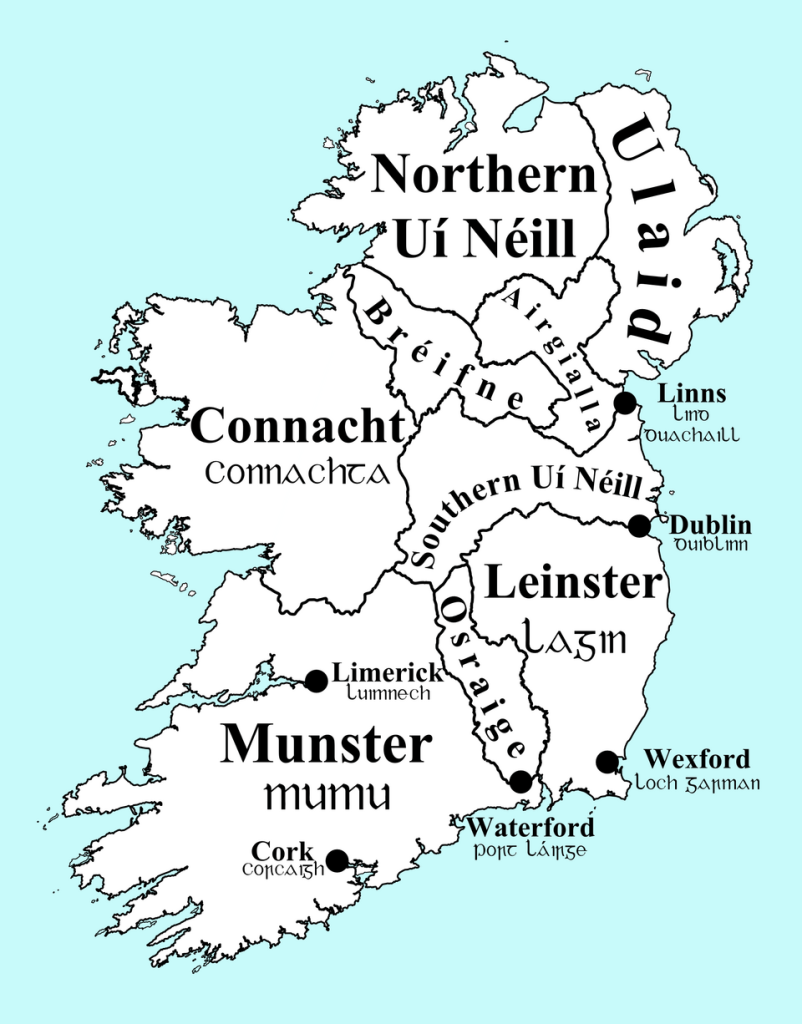
Reproduced by permission (Public domain) https://commons.wikimedia.org/wiki/File:Ireland900.png
It is in this year (848) we hear about two victories gained by Ólchobar mac Cináeda, king of Munster since the previous year. In one he demolished the fort at Cork “for Ghallaibh/gentibh” (against/taking it from the foreigners/heathens)[11]. The other has more significance as a piece of history. There are four references[12]:
1: Annals of Ulster 848.5: “Bellum re n-Olcobur, ri Muman, ⁊ re Lorggan m. Cellaig co Laighniu for gennti ecc Sciaith Nechtain in quo ceciderunt Tomrair erell, tanise righ Laithlinne, ⁊ da cet dec imbi.”
(Ólchobor, king of Mumu, and Lorcán son of Cellach, with the Laigin, won a battle against the heathens at Sciath Nechtain, in which fell the jarl Tomrair, tanist of the king of Laithlinn, and two hundred about him.)
2. Annals of the Four Masters 846: “Cath oile ria n-Olchobhar, rí Mumhan, ⁊ ria Lorcán, mac Ceallaigh, rí Laighęn co Laighnibh ⁊ Muimhneachaibh iompa for Ghallaibh, acc Scéith Nęchtain, in ro marbhadh Tomhrair Erla, tanaisi righ Lochlainne, ⁊ dá céd décc uime.”
(Another battle was gained by Olchobhar, King of Munster, and by Lorcan, son of Ceallach, King of Leinster, having the Leinstermen and Munstermen along with them, over the foreigners, at Sciath Neachtain, wherein Tomhrair Earl, tanist of the King of Lochlann, and twelve hundred along with him, were slain.)
3. Annals of Inisfallen 848.2: “Cath Sceth Nechtain h-i Laignib ré n-Ólchobur for Gullu i torchair Tomrair iarlae.”
(The battle of Sciath Nechtain in Laigin [gained] by Ólchobar over the foreigners, in which Tomrair the Jarl fell.)
4. Chronicon Scotorum 848.4: “Cath re n-Olcobhur rí Muman & re Lorcán mac Cathlaich co Laignibh for gentibh is Sciaigh Nechtain in quo cecidit Tomrair iarla tanaissi righ Lochlánn et da ced dec immi.
(Ólchobur, king of Mumu, and Lorcan son of Cathlaech, with the Laigin, won a battle against the heathens at Sciath Nechtain, in which fell the jarl Tomrair, tanist of the king of Lochlann, and twelve hundred about him.)
In summary we have Ólchobar joining forces with Lorcán mac Cellaig, King of Leinster, to defeat the Norse at Sciath Nechtain[13]. The earliest source (Annals of Ulster) states that 200 vikings perished, although in later accounts this has increased to 1,200, and amongst the dead was a Jarl (or Earl) called Tomrair, a character who is also described as the tanist (or Deputy) of the “King of Laithlinn (or Lochlann).” I will come back to Tomrair shortly but in the meantime, I will finish with my timeline of the 840s.
849: In this year, fighting continued between the Norse and the Irish. Meal Sechnaill teamed up with Tigernach and they attacked Dublin[14] while the vikings killed Mael Bresail, son of Cernach, after he had entered the clerical life[15]. However we also see an interesting development as reported in the Annals of Ulster[16]:
“Muirfhecht .uii.xx. long di muinntir righ Gall du thiachtain du tabairt greamma forsna Gaillu ro badur ara ciunn co commascsat h-Erinn n-uile iarum.”
“A naval expedition of seven score (140) ships of adherents of the king of the foreigners came to exact obedience from the foreigners who were in Ireland before them, and afterwards they caused confusion in the whole country.”
We now have the “foreigners” (aka heathens, Norse or Vikings) fighting among themselves to establish supremacy in Ireland. Amongst all this strife, some of the relics of St Columba were transferred from Iona to Ireland[17], perhaps relatively speaking, safer than Iona. The rest went to Dunkeld in the realm of Kenneth MacAlpin[18].
Returning to Tomrair, he is the fourth named Norse leader we have met (after Saxolb, Turges and Hakon). Clearly of some importance, he is the first Jarl mentioned in the Annals. In A Very Short Interlude Across the North Sea I described the three classes of society in Scandinavia at the time. The Jarls were the aristocracy: landowners and employers who were sometimes the supreme leaders of a particular area (in place of a “king”) while at other times they answered to the king. As well as being a Jarl, Tomrair is said to be the deputy (or perhaps heir) of the king of Laithlinn (Annals of Ulster) or Lochlann (Annals of the Four Masters and Chronicon Scotorum).
The location of this place is one of the unsolved mysteries of early medieval history. The earlier source (Annals of Ulster) uses a word similar to Laithlinn and this is also the case in a 9th century Old Irish poem which runs:
Is acher in gaíth in-nocht,
fu·fúasna fairggae findfholt;
ní·ágor réimm Mora Minn
dond láechraid lainn úa Lothlind.
This can be translated as:
Bitter is the wind tonight,
it stirs up the white-waved sea.
I do not fear the coursing of the Irish sea
by the fierce warriors of Lothlind.
The translation and audio version are available from the University of Cambridge here. [19]
In later sources the spelling changes, with “ch” replacing “th”, so we get “Lochlann” and (assuming that these two versions refer to the same place) this is a word used today in Irish and Scots Gaelic when referring to Norway or Scandinavia. Does this mean that a king of Norway (which was not yet a united country) had sent his deputy over to Ireland? Historians have mixed views and while I am not about to embark on a detailed discussion of the topic, I would draw your attention to some relatively recent publications from Arne Kruse (2017)[20] and Colmán Etchingham (2007)[21] – both favouring somewhere in Norway – and Donnchadh Ó Corráin (1998)[22] and Dirk Steinforth (2020)[23] who suggest that Laithlinn was (part of) Viking Scotland. Perhaps there is a middle way with a term originally from Norway also becoming attached in Irish and British sources to those Norse settlers in Scotland who would go on to attack Ireland[24].
In that regard, it is worth remembering that by 850 the “Vikings” had established themselves in areas of what is now Scotland and Ireland. In Arrival of the Norwegians: Early Kings and The Family of Ketil Flatnose I suggested (as part of my test to see if a credible timeline can be established) that Ketil had arrived with his family in the western isles in the year 849 – a scenario which is later mixed up into various versions in the sagas – and had been accepted, or had established himself as some sort of leader there. Could it be possible that he was a key ally of the King of Laithlinn (whoever he was) and that this King was now turning his conquering thoughts to Ireland, fighting for supremacy against not just the Irish, but also the other Norse who had already been established there for some decades? As well as fighting the Irish, we now have Vikings attacking Vikings and this narrative is in danger of becoming even more confusing. Fortunately the annalists seem to have come up with a way of distinguishing the established vikings from the more recent arrivals – by colour-coding them, and that is something I will look at, alongside more references to Laithlinn/Lochlan in the next post.
[1] Annals of the Four Masters (A4M) 844.12; Chronicon Scotorum (CS) 846.4; Annals of Ulster (AU) 846.6
[2] A4M 844.13
[3] AU 846.2
[4] A4M 845.13
[5] A4M 845.12
[6] AU 847.4; CS 847.3
[7] AU 847.3; CS 847.2; A4M 845.6. The Luigni and Gailenga are usually described/translated as fighting “under the influence of” or “in the manner of” the heathens.
[8] AU 848.4; Annals from the Book of Leinster (ABL) 3114-5
[9] AU 848.6; A4M 846.9
[10] A4M 846.10; CS 848.6; AU 848.7
[11] A4M 846.11; CS 848.7
[12] Translations as per CELT (Corpus of Electronic Texts)
[13] near what is now Castledermot, County Kildare
[14] A4M 847.16; CS 849.3
[15] A4M 847.18; AU 849.10; CS 849.6
[16] AU 849.6. See also A4M 847.17; CS 849.5
[17] AU 849.7
[18] See The Last Pictish Kings: Part 2 – Kenneth, Brude, Drust… and Kenneth
[19] The Annals of Ulster 853.2 later uses the version “Laithlinde”– as we shall see in a future post, while the Annals of the Four Masters 866.10 quotes a separate poem, using “laith linn”.
[20] Arne Kruse: The Norway To Be: Laithlind And Avaldsnes (SSNS publication)
[21] Proceedings of the Seventh Symposium of Societas Celtologica Nordica, pages 11-31 available here
[22] Vikings in Ireland and Scotland
[23] Whence and Whither, Óláfr? (SSNS Publication)
[24] A precursor to the much later Norwegian monarchy’s rule over parts of Scotland?

 The Northern Tapestry

Leave a comment