
In this post I want to turn once again towards Scandinavia. In the early 9th century the land now called Norway was not united. Instead there existed a number of kingdoms such as Vestfold, Rogaland, Romsdal and Sogn. Just as we have seen Kenneth MacAlpin being linked with the uniting of different realms into a larger one known as Alba (and then Scotland), we will meet a character called Harald Fairhair who was later credited with being the first king of a united Norway. That is still a few decades away, but, as ever, history has confused some of the timelines which are relevant to this Tapestry.
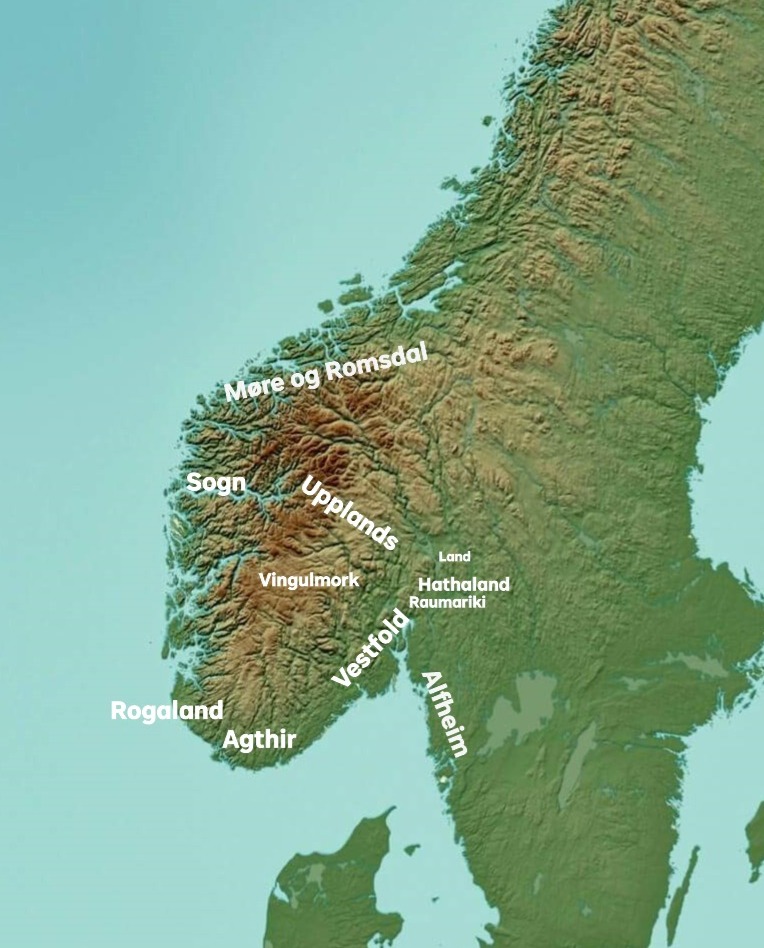
The sources for this period are less reliable than the Annals I have used when looking into early Scottish and Irish history and are mainly based on texts written down in Iceland (which in our timeline has yet to be “discovered”) in the 13th and 14th centuries, although some are earlier and all were almost certainly based on existing oral records.
I have set out elsewhere the historical limitations of Heimskringla, but this document is an invaluable source for “what could have been” in any tapestry depicting the early medieval north. Possibly written in the early 13th century by Snorri Sturluson, an Icelandic writer and politician who is also said to have been the author of such works as the Poetic Edda and Egil’s Saga, the work contains a number of kings’ sagas which purport to tell the history of Norwegian kings (and other major characters) and who were said to have been the descendants of the god Odin
The book begins with a description of the Kringla heimsins (“the orb or disc of the earth”, from which the name of the book is derived) and of the great warrior and chief called Odin who rules the Æsir people, leading them to an inconclusive war against another people (the Vanir). Eventually the two make peace and exchange hostages. This brings Njorð to the Æsir, along with his son and daughter, Frey and Freya.
This, the saga explains, was all happening at the time of the Roman Empire. Odin has a vision in which he comes to rule in the north, so he takes a number of his people with him to Scandinavia, leaving his two brothers behind to watch over Asgarth (the land of the Æsir) and those remaining there. When Odin dies – yes in this version Odin, written by the Christian Snorri, is no god, although he does have some magic skills – he is succeeded by Frey (also no god) who is called “king of the Swedes.”
What then follows are the summarised biographies of a number of rulers. Frey is succeeded by his son, Fjölnir, and then we have:
- Sveigðir, son of Fjölnir
- Vanlandi, son of Sveigðir
- Visbur, son of Vanlandi
- Domaldi, son of Visbur
- Domar, son of Domaldi
- Dyygvi, son of Domar
- Dag, son of Dyggvi
- Agni, son of Dag
- Alrek and Eirik, sons of Agni (who kill each other)
- Yngvi and Alf, sons of Alrek (who also manage to kill each other)
- Hugleik, son of Alf
- Jorund, son of Yngvi
- Aun, son of Jorund
- Egil, son of Aun
- Ottar, son of Egil
- Athils, son of Ottar
- Eystein, another son of Ottar
- Yngvar, son of Eystein
- Onund, son of Yngvar
- Ingjald, son of Onund
- Olaf, son of Ingjald
- Halfdan “Whiteleg”, son of Olaf
- Eystein, son of Halfdan
- Halfdan the “Generous”, son of Eystein
- Guðroð, son of Halfdan
By the time of Guðroð’s death we have (probably) reached the early decades of the 9th century, which could fit in with the 23+ generations above from Roman times. Sometimes known as the Hunter-King or “the Magnificent”, Guðroð married twice according to the legends and added half of the area of Vingulmork (at the head of the Oslosfjord) to his Vestfold realm as part of the dowry from his first wife Álfhild, the daughter of another petty king, Álfar of Álfheim.
Guðroð and Álfhild had a child who was called Olaf but when his wife died, Guðroð sought the hand of Princess Ása, daughter of King Harald Redbeard of Agthir (the southernmost province of Norway). When the proposal was rejected, Guðroð launched an attack on Harald, killing him and capturing his daughter. The “Hunter King” became a father for the second time through this union and the child was named Halfdan. In my suggested timeline Halfdan would have been born around 819. His father did not live to see him grow up – he was assassinated the following year by an associate of the reluctant Queen Ása.
Olaf, now 20 years old, gained possession of his father’s territories in Westfold – the half part of Vingulmork was lost to another king called Gandalf – but when his half-brother Halfdan reached the age of 20, the kingdom was shared equally between them. When Olaf died from a leg disease, his share of Vestfold passed in turn to his son Rognvald.
Halfdan, who on account of the colour of his hair was known as “the Black,” had grown up back in his mother’s homeland of Agthir and he had become ruler in Agthir two years before he received his share of Vestfold from his brother (837). Clearly ambitious, Harald began adding more territories to his realm. First he managed to win back the half of Vingulmork which his father Guðroð had once held; then he added the territory of Raumariki, nearby Land near Lake Mjösen, and Hathaland. As his Saga in Heimskringla says:
“var hann þá ríkr konungr” (“he was a very powerful king”)[1]
Like his father, Halfdan also married twice. His first wife was Ragnhild, daughter of King Harald Gulskeg (Goldbeard) of Sogn.[2] Their son, Harald, inherited Sogn on his grandfather’s death. Ragnhild and Harald died at some point, but this gave Halfdan the chance to claim that land as his son’s heir, and this was soon achieved, albeit following a show of some force. Halfdan also appears to have held realms in the Upplands.
Following a series of battles with the sons of Gandalf (the king who had temporarily taken Guðroð’s share of Vingulmork), Halfdan succeeded in now bringing all of that land under his control.
The author of Heimskringla then provides an example of one of those beautiful set-pieces contained in the sags which owe far more to legend than factual history. He tells us the story of Sigurð Hart, the great-grandson of Ragnar Lothbrok (via his mother Aslaug and her father – and Ragnar’s son – Sigurð Snake-in-the-Eye). Sigurð Hart had two children – a daughter called Ragnhild, who was “a woman of exceeding beauty and excellence” – and a son whose name was Guðorm. When Ragnhild was 20, her father was killed while out riding alone in the woods: he was attacked by the berserker Haki and thirty of his men. Sigurð managed to slay twelve of these and severely wounded Haki before succumbing – such was his bravery and strength.
Haki did however manage to make it to Sigurð’s property and there seized cattle, valuables, Ragnhild and Guðorm. The berserker intended to marry the young woman but the wedding was postponed while he recovered from the injuries that Sigurð had inflicting on him.
When Halfdan heard of these events, he ordered one of his men (who went by the name of Harald Magic Wand[3]) to go to Haki’s estates and “rescue” the kidnapped son and daughter. Magic Wand did this, while also relieving Haki of other valuables. When the berserker realised he had lost, he fell on his own sword. Ragnhild then married Halfdan instead. Whether she was grateful for this, or whether she was just seen by all the men concerned as a piece of war booty, is not recorded.
In time the couple had a son who was, like Halfdan’s (now deceased) firstborn –– given the name Harald. The saga tells us that this Harald:
“var brátt mikill ok inn fríðasti; … ok gerðisk brátt iþróttamaðr mikill, vel viti borinn; móðir hans unni honum mikit, en faðir hans minna.”
(“quickly grew up into a tall handsome man…he soon became accomplished as a man of good understanding. His mother loved him dearly, but his father less so.”)
I am going to record his year of birth as 850 and he was ten years old when his father died in 860. This child would later become known as Harald Fairhair.[4]
While this is probably more legend than history, the two are beginning to merge.
Two of the sources which Snorri may have had access to when writing Heimskringla were the Íslendingabók and the earlier versions of the Landnámabók.
The Íslendingabók, written in the first half of the 12th Century mentions our characters:
“ Goðröðar veiðikonungs, föður Hálfdanar ins svarta, föður Haralds ins hárfagra”[5]
Landnámabók mentions Harald as context for the Settlement of Iceland after 870. This work, usually translated as The Book of Settlements is an astonishing record of the foundation of Iceland, naming the original settlers, the land they took, and their descendants. Probably dating originally from the 11th century, it was written down at least two hundred years after some of its events and while its absolute accuracy may be questioned, it is likely to have survived initially through oral history, hence why the writer of Heimskringla probably had access to its earlier versions.
In A Very Short Interlude Across the North Sea, I introduced the Norwegian hersir Bjorn Buna, with Landnámabók teasing us by noting that of Bjorn’s sons “er frá þeira afkvæmi margt sagt í þessi bók[6]” (“a great deal will be said about their children in this book.”).
There were at least three sons known to us: Ketil (or Ketill), who I suggested had been born in 810 (see The Islands of Sheep: Settlement of The Faroes), Hrapp and Helgi. Ketil Flatnose (as he would become) is one of the better-known figures from the sagas whose story is told alongside historical sources and events and the story of this family is tied up with events taking place in Norway, Scotland, Ireland and Iceland. Landnámabók[7] tells us that Ketil married Yngvildur, daughter of Ketil, a chieftain in Hringaríki. They had two sons and two daughters:
- Bjorn “the Easterner” – son 1
- Helgi Bjola – son 2
- Auð “the Deep-minded” (Auðr djúpúðga) – daughter 1
- Þórunn “the Horned” (hyrna) – daughter 2
At some point in the 9th century, Ketil brought (almost all of) his family from Norway to the land of the Picts and Scots. Why was this? Turning again to Landnámabók, we are told that this was on the orders of King Harald Fairhair:
“Harald Fairhair sailed west across the ocean, as is written in his saga. He conquered all the Hebrides (Suðreyjar) so far west that no one has since acquired any further. But when he went home[8], Vikings and Scots and Irish[9] invaded the islands and plundered and killed in many places. When King Harald learned about this, he sent Ketil to reconquer the islands.”
Ketil obeyed this order, leaving one of his sons, Bjorn. He then conquered all the southern isles and he soon became chief of the Hebrides. However he decided he would pay no taxes to Harald and therefore became an enemy of the king.
A similar tale is told at the beginning of Eyrbyggja Saga. Ketil is described as a famous hersir[10], with five children, the additional one being a third daughter called Jorun Manvitsbrekka (“breaker of men’s wits”). His son Bjorn was fostered in Jamtaland (now in Sweden) by Earl Kjallak, a wise and noble man. Again we are “in the days when King Harald Fairhair came to power in Norway[11]”.
Many men had left Norway because of Harald and gone to places like the Hebrides and Orkney, but each summer they would attack and raid Norway and therefore the King ordered Ketil to lead an army across the sea. Victorious, he then took over the Hebrides and made himself chief over them. Then “he made peace with the mightiest chiefs in the Western Isles, and made alliances with them, and he sent the (king’s) army back east (to Norway).[12]”
On their return, the victorious soldiers “said that Ketil Flatnose was lord of the Hebrides, but that they did not know if he was holding that position in Harald’s name or his own. When the king heard that, he confiscated the lands that Ketil owned in Norway.[13]”
Another text which mentions these events is Laxdæla Saga[14] which gives us a slightly different version. We are told that Ketil, a mighty and high-born chieftain who lived in Romsdal in Norway, was forced (as were others) to submit to King Harald Fairhair, who was in the process of uniting Norway or flee that country.
The saga says that in the latter days of Ketil, King Harald Fairhair had grown so powerful that only those who supported him could thrive. Referring to some previous enmity between his kin and the king[15], Ketil asked his kinsmen what they should do: whether to submit or fight. His son, Bjorn the Easterner, said that he preferred to follow the example of other noble men and emigrate to Iceland which had only recently been “discovered.” Bjorn’s brother, Helgi, agreed and they both impressed on the others that in Iceland there was good land and fishing all year round (fish and whale). Ketil was less impressed so that he did not intend to spend his remaining years “in that fishing camp.” And he would rather travel to the Hebrides – a place he knew well from his earlier raiding days.
After that Ketil held a great feast, combined with a betrothal for his daughter Þórunn to Helgi the Lean and Ketil soon left the country. His daughter Auð and others are named as fellow travellers although the saga states that his sons went to Iceland with Helgi the Lean.
Again we have a timeline discrepancy here – the colonisation of Iceland was still three decades away – and there is no reference in this version of Ketil fighting or conquering the Hebrides.
When he arrives, he is “well received by the great men there; for he was a renowned man, and of high birth.[16]”
I will come back to Ketil and his life in Scotland – and to his children – in a future post but for now want to comment on the reason for his arrival there. All three of the versions above link his emigration to Harald Fairhair and this is a problem. If Harald was not born until 850 (as above) then this would suggest that Ketil and his family did not move until around 870, or perhaps a little earlier. However Ketil would then have been in his 60s and his children in their 30s and 40s. We will also see how his daughter Auð, is linked in the texts to an emerging Hiberno-Norse leader called Olaf at a time which must have been earlier than the 870s and she would give birth to a son, Thorstein who was active as a warrior in the second half of the 9th century. We have already seen in The Islands of Sheep: Settlement of The Faroes , how Ketil had a granddaughter (Helga) who married a great-grandson of Grim Kamban, the legendary first settler of the Faroe Islands, which also supports an earlier timeline for Ketil.[17]
It is possible that there are two stories being combined here. The first is when Ketil and his family move to Scotland and take control of lands there, while maintaining some connection with their homeland. This may be being mixed up with a later episode where he falls out with Harald and this leads to the full expulsion of Ketil from Norway. As I say, I will come back to these characters soon, but in summary I think that it is more likely that Ketil and his family (except Bjorn) left Norway in 848 and the proposed timeline of some events would look like this:
- 810: Ketil Flatnose born
- 819: Halfdan the Black born
- 829: Ketil and Ingveldur marry
- 830: Auð the Deepminded born
- 838: Helgi Bjola born
- 840: Jorunn Mannvitsbrekka born
- 842: Bjorn “the Easterner” born
- 844: þorunn hyrna born
- 847: Bjorn fostered by Earl Kjallak
- 848: Ketil and most of his family move to Scotland
- 849: Auð marries Olaf
- 850: Harald Fairhair born
- 850: Thorstein, son of Auð and Olaf is born
To summarise: By the end of the 840s, the smaller kingdoms of “Norway” are beginning to fuse together under the rule of fewer individuals, one of which is Halfdan the Black, father of soon-to-be-born Harald (Fairhair). At the same time (and perhaps not unconnected), the Norse expansion has continued and certain characters are starting to set themselves up as leaders, even being called kings, in the British Isles and it is to there I aim to return next.
[1] Saga Hálfdanar svarta (FJ) – heimskringla.no
[2] At the outlet of lake Mjösen
[3] Harald Gand
[4] Haraldr Hárfagri – sometimes called “Fine Hair” – both terms mean something like “beautiful” rather than to do with colour or thickness of hair! But in due course there is a story to be told about how he came to be known by this nickname.
[5] “Guðroð the Hunter-King, father of Halfdan the Black, father of Harald Fairhair”- Íslendingabók – preface, available here
[6] Landnámabók Chapter 10. I will follow the chapter headings given by Hermann Palsson and Paul Edwards in their University of Manitoba Press edition (1972), but an Old Norse version can be found here: Landnámabók. I-III. Hauksbók. Sturlubók. Melabók m. m. Udgiven af Det kongelige nordisk oldskrift-selskab : Finnur Jónsson, 1858-1934
[7] Landnámabók Chapter 13
[8] Ibid. Presumably, although the text gives his direction as west: “En er hann for vestann sloguzt”
[9] “vikingar ok Skotar ok Irar”
[10] For further discussion of hersirs, see A Very Short Interlude Across the North Sea – The Northern Tapestry
[11] “Þetta var í þann tima, er Haraldr konungr inn hárfagri gekk til ríkis í Nóregi.” Eyrbyggja Saga Chapter 1. Available in Old Norse here: Eyrbyggja saga – heimskringla.no
[12] “Sættist hann þá við ina stærstu höfðingja fyrir vestan haf ok batt við þá tengðir, en sendi austr aftr herinn.”
[13] “sögðu þeir, at Ketill flatnefr var höfðingi í Suðreyjum, en eigi sögðust þeir vita, at hann drægi Haraldi konungi ríki fyrir vestan haf. En er konungr spyrr þetta, þá tekr hann undir sik eignir þær, er Ketill átti í Nóregi.”
[14] Old Norse version available here: Laxdaela saga : Sveinsson, Benedikt
[15] “Kunnig hafa yðr verit skifti vár Haralds konungs, ok þarf eigi þau at inna, þvi at oss berr meiri nauðsyn til at ráða um vandkvæði þau, er vér eigum fyrir höndum” (“You all know what issues there have been between me and King Harald, and there is no need to repeat these here”) – unfortunately for us!
[16] Ketill flatnefr kom skipi sínu við Skotland ok fekk góðar viðtökur af tígnum mönnum, því at hann var frægr maðr ok stórættaðr.”
[17] The groom (Auður the Rotten) was the daughter of Thorolf Butter who, we will see, was involved in the discovery of Iceland in the 860s, suggesting that the marriage took place in the 880s. If we said 885 and if Helga married when she was 20, she would have been born in 865, when her father Helgi was 27. So that can make sense.


 The Northern Tapestry
Leave a comment