
In the last post we saw how, after the catastrophic defeat by the Norse in 839 which impacted both the Picts and the Dál Riadan Scots, Uurad ruled in Pictland for three years, and was based in Perthshire. His son, Bred, then ruled for one year. For those who followed, the truth becomes murkier, not helped by the tales that would grow up around a king who was probably already in power in Dál Riada and who would also extend his rule to encompass the Picts: Kenneth MacAlpin.
We saw how some sources tell of three other kings who ruled after Bred’s death in approximately 842 or 843. As ever, these sources all have different spellings (as illustrated in The Last Pictish Kings: Part 1 – Uurad and Bred) but for consistency I will use the following names in this blog:
- Kenneth, son of Uurad – ruled for 1 year
- Brude, son of Fodal – ruled for 2 years
- Drust, son of Uurad – ruled for 3 years
If these reigns were consecutive rather than concurrent, and knowing that each year described was possibly a little less than 12 months, then this would take us up to perhaps 847 or 848.
Other than their names, we know very little else about them. Kenneth (reigning 843) and Drust (845-848) were brothers, following their way to the throne in the footsteps of their brother Bred (842-843) and father Uurad (839-842). Brude, son of Fodal managed to disrupt the family’s control for a couple of years (843-845).
Version A of the Pictish King Lists (The Poppleton Manuscript) does not include these three kings and jumps straight from Bred to Kinadius filius Alpini[1] (Kenneth, son of Alpin) as the document moves into the section sometimes known as the Chronicle of the Kings of Alba. Of this character we are told that:
“Kenneth, son of Alpin, the first of the Scots, ruled Pictavia happily for 16 years. Pictavia was named after the Picts, whom, as we said, Kenneth destroyed. For God, to punish them for their malice, deigned to make them estranged and idle to their heritage: because they not only scorned the Lord’s mass and commandments, but were also unwilling to be reckoned equal to others in the law of equity. Indeed, two years before he came to Pictavia, he took over the kingdom of Dál Riada. In the seventh year of his rule, he transferred the relics of Saint Columba to the church which he had built, and he attacked Saxonia six times. He burned down Dunbar and captured Melrose. But the Britons burned down Dunblane, and the Danari laid waste to Pictavia, as far as Clunie and Dunkeld. In the end, he died of a (rectal?) tumour, before the Ides of February on the third day of the week (Tuesday 13th) in the palace of Forteviot.”[2]
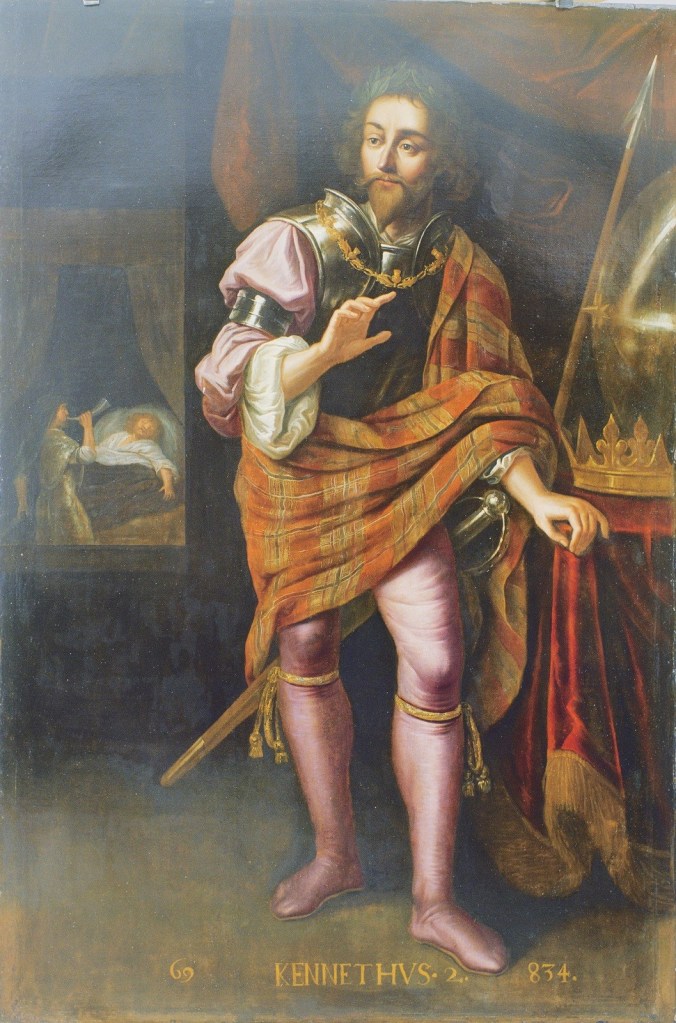
This is a summarised biography containing a number of notable events and we will return to some of these in the next post. The words “as we said” in the second sentence also suggest this was part of a longer work, with only this paragraph surviving and included in the chronicle.
Saxonia presumably refers to Anglo-Saxon Northumbria and it is interesting to note the reference to “Danari”. This does not mean Danes as we would think of them now, but is probably a later medieval word acknowledging that these were Scandinavian raiders – i.e. vikings.
The versions which mention the three intervening kings tell us that[3]
- Drust, the third son of Uurad and last of the three kings, was killed at either Forteviot or Scone (both near modern-day Perth)
- His successor, Kenneth, ruled the Scots for sixteen years[4], having destroyed the Picts, and
- He died at Forteviot and was buried on Iona
- As king, Kenneth led the Scots from Argyll into the land of the Picts with “wonderful courage” (or “hot anger”) [5]
Other meagre references to Kenneth in the Irish annals relate to the year of his death (858):
- Annals of Ulster 858.2: “Cinaedh m. Ailpin rex Pictorum, Adulf rex Saxan, mortui sunt” (dying in the same year as the Saxon king Adulf)
- Fragmentary Annals of Ireland 285 (858): “Cionaodh mc. Ailpin, rex Pictorum, m.”
- Annals of Inisfallen 858.3: “Cináed macc Alpín, ri Alban.”
Note that he is described as king of the Picts or king of Alba – a name which was to take hold later, but an illustration of the belief that Kenneth MacAlpin was the first to unite the Picts and Dál Riadan people into a single country called Alba (and eventually Scotland).
One of the sources mentioned above notes that: “Et tunc translatum est regnum Scotorum ad terram Pictorum”[6] which I think means something like “it was at this time that the reign of the Scots was transferred to cover the land of the Picts,” although linguistically it could be ambiguous. Skene does not provide his translation for this and I suspect this was a later reinforcing of the line that what we have here is a Dál Riadan takeover of the Picts.
One of the greatest unknowns of early Scottish history is the answer to the question – was Kenneth MacAlpin a Pict or a Scot? What was his background?
To find this out we need to turn to some later sources, accepting that as time goes by, their reliability becomes less secure.
Rawlinson B 502
Among the genealogies included in the 11th or 12th century manuscript known as Rawlinson B 502[7], there is one which sets out a list dating back from the Scottish king Malcom II (who reigned 1005-1034) to prehistory and the legendary kings of Ireland. This includes the following:
“Máel Coluim macc Cináeda m. Máel Coluim m. Domnaill m. Causantín m. Cináeda m. Alpín m. Echdach m. Áeda Find m. Domongairt m. Domnaill Bricc m. Echach Buidi m. Áedáin m. Gabráin”
In the highlighted text, Kenneth’s father is listed here as Alpin, grandson of Aed Find, whom we met in Kings in the North as a Dál Riadan king who managed to re-establish some independence from the Picts after the death of Onuist I in 761. Aed died in 778, with his brother Fergus taking over, but then we have a period of uncertainty before succumbing once again to Pictish authority in the early 9th century.
The Annals of Ulster give a different father for the two brothers (i.e. not the Domongairt mentioned in Rawlinson B502): Aedh Finn m. Echdach (778.7) and Fergus m. Ecach (781.3); but it is Aed’s son who is important here. Also called Eochaid (and Echdach), he is said in the text quoted above to be the father of Alpin.
Duan Albanach and Synchronisations of Flann Mainistreach (11th century)
The 11th century Duan Albanach (in the Irish version of Nennius’ Historia Britonum) states that after reigning for four years (possibly 835-839), Aed mac Boanta was succeeded by an Eoghanan who reigned for thirteen years[8]. This seems to refer to the son of Onuist II – but that son had died in battle against the vikings, with his brother Bran in 839 and alongside Aed. The “Synchronisations of Flann Mainistreach” also from the 11th century call him “Eoganan mac Aengusa”[9]. Alpin himself is not mentioned in the Duan Albanach which follows Eoghanan with: “Tríocha bliadhain Cionaoith chruaidh” (“Thirty years of Kenneth the Hardy”). In the Synchronisms he is mentioned only as the father of Kenneth.
Is it possible that Eochaid (also named elsewhere as Echach, Ecach and Echdach) has at some point become confused with Eoghanan? While this is unlikely, what seems more of a possibility is that Eochaid is the mysterious King Achaius I looked at in Onuist II and the Flag of Scotland, as discussed below.
Boece and Buchanan (16th century), David Hume of Goscroft (17th century) and Matthew Duncan (18th century)
Described by Hector Boece in his 1527 History and Chronicles of Scotland[10] as Onuist II’s “brother-in-law”, Achaius responded to the Pictish king’s request for help in fighting and defeating Athelstan in the year 832. Unfortunately the little “evidence” we have about his place in Scottish history is very confused. As set out in that previous post, Boece says that Achaius was the son of Ethfine (i.e. Aed Find), and he became king following the death of his predecessor in that role, Solvathius. This royal line was supported by later writers including George Buchanan in his “Rerum Scoticarum Historia” in 1582[11] and David Hume of Godscroft in his “History of the House and Race of Douglas and Angus” in 1644[12].
A much later work (but presumably deriving from an earlier source which is now lost) is “The History of the Kings of Scotland from Fergus I to the End of Queen Ann’s Reign” by Matthew Duncan in 1722[13]. This adds another king to the line, stating that that:
“Alpinus, the 68th King of Scotland, son of King Achaius, succeeded Dongallus, the son of Solvathius.”
This certainly helps to link the two – Achaius and Eochaid – together. If we can trust the sources. Also of interest however is the statement that Alpin defeated and killed the Pictish usurper Frederethus in a battle in Angus. With a little stretching of the imagination, might we see this as Uurad/Ferat, the Pictish King who died in 842?
John of Fordun (14th century)
According to John of Fordun, Alpin reigned after the death of someone called Dongallus, as repeated later by Matthew Duncan. In Constantin, son of Uurguist/son of Fergus I outlined that the death of Fergus in 781 was followed by the rule in Dál Riada of Donncoirce until 792 and then we have a gap until the two Conalls took power in 805-807 and 807-811. This was then followed by Pictish authority until 835 (and the ascendancy of Aed son of Boanta – see Vikings v Picts, Scots, Irish and Anglo-Saxons), although it is possible of course that certain chieftains were allowed to rule with Pictish permission as vassals. Was Aed still required to take his lead from the Picts and were Fordun’s Dongallus and Alpin two of these vassals who both rebelled against the Pictish overlordship?
Fordun presents Alpin as an independent (or independent-minded) king who succeeded to the kingship in 831 or 832 and then took on the Picts but died in the third year of his reign (834):
“With unflagging exertions, he continued[14] the war against the Picts, which was begun by his predecessors, ravaging them constantly with his armies, or by repeated inroads. Accordingly, in the third year of his reign, during the Easter festival, the Scots came to conflict with the Picts, and many of their nobles fell. Whereupon it came to pass that Alpin, being victorious, was puffed up with pride; and, rashly engaging them in a second battle, the same year, on the 20th of July, he was defeated, taken, and all ransom being refused, beheaded. He was beyond measure prone to war, and in all his actions too hasty and impetuous.”[15]
The Chronicle of Huntingdon (13th century)
This Chronicle [16] notes that Alpin died in 834 and his son Kenneth then reigned for 28 years (i.e. to 862 – some four years after the date of his death reported in the Annals). It also notes that:
- In, 834, the Scots met with the Picts at the feast of Easter and “many of the noblest of the Picts fell”
- Alpin, puffed up with pride, went to war again on 13th August, but he was killed in that battle.
- His son Kenneth succeeded him, and in the eighth year of his reign (841/2?), when the Picts had suffered significant defeats in trying to protect their land from the vikings, he took advantage and thus took over the monarchy of the whole of Alba and was the first King of the Scots
- In the 12th year of his reign (846?) he “fought seven times in one day with the Picts and, after many defeats, confirmed his kingdom for himself and reigned for 28 years.”[17]
Chronicon Elegiacum (13th century)
Dating from 1270, the Chronicon Elegiacum presents the view that Kenneth ruled for 16 years “expulsis pictis” – which could mean “having expelled the Picts.”[18]
The Chronicle of Melrose: (12th century)
This chronicle states that Alpin reigned from 841-843 and he was followed by his son Kenneth, who died in 859[19].
Chronicon Rhythmicum (15th century)
This record[20] notes that Alpin ruled for three years, followed by Kenedus, son of Alpyn, who ruled “tempore Picti” (“during the time of the Picts”) for seven years…. and then:
“postquam Kenedus Pictos omnino fugauit, annos octo bis regnando continuauit.” (“after Kenneth completely drove out the Picts, he continued to reign for sixteen years.”
Summary and Suggested Scenario
It is almost impossible to pin down exactly the events leading to the accession of Kenneth MacAlpin. From the information we have however, my suggested version is as follows:
The deaths of Aed mac Boanta and Uuen son of Onuist in 839 saw Eochaid (or Achaius) son of Aed Find assume the Dál Riadan throne, where he reigned for three years (839, 840 and 841).[21] His part in the legend of the Saltire – the defeat of Athelastan by Onuist II – is said to have taken place earlier when Pictish authority held more sway over the Scots, perhaps in 832.
In Pictavia, Uurad/Ferat took control from 839 until 842, then Bred until 843 (as set out in The Last Pictish Kings: Part 1 – Uurad and Bred). In Dál Riada, after the death of his father Eochaid/Achaius, Alpin became a dominating character – perhaps “a” or indeed even “the” king – and when he died in action in 843, his son Kenneth took over. Coincidentally this was when another Kenneth (Kynat filius Ferant) is said by some sources to have been king of Picts.
It is at this time that the power balance seems to shift, with Dál Riadan figures disputing Pictish ascendancy and somehow turning that around so that it become a Dál Riadan aspiration to rule over the Picts.
Kenneth MacAlpin’s claim over the Picts continued throughout and despite the other Kenneth’s short reign (less than a year) and into the following reigns of Brude (843-5) and Drust (845-8), before he finally succeeded in ruling both peoples until his death in 858, 859 or perhaps a little later. With a little bit of mopping up to be done after Drust’s death – i.e. dealing with any other rival Pictish claims – this timeline just about fits in with the Poppleton Manuscript’s note that in “the seventh year of his rule,” Kenneth “transferred the relics of Saint Columba to the church which he had built.” If this refers to the seventh year after (and including) 843, this would be 849, and would seem to fit with his confidence in transferring the relics to Pictish territory, possibly Dunkeld, just north of Perth.
In summary, this would give:
| Dál Riada | Picts |
| 811-835: Domnall (Pictish authority) | Onuist II 820-834 |
| 835-839: Aed son of Boanta* | 834-837: Drest son, son of Constantin and Talorgen, son of Vuthoil |
| 837-839: Uuen, son of Onuist | |
| 839-841: Eochaid* | 839-842: Uurad/Ferat |
| 841-843: Alpin*, son of Eochaid | 842-843: Bred, son of Ferat |
| 843-845: Kenneth, son of Alpin | 843: Kenneth, son of Ferat |
| (Kenneth, son of Alpin claims Pictish throne too sometime after 843, but does not take full control until 848) | 843-845: Brude, son of Fodal |
| 845-848: Drust, son of Ferat |
* continuing Pictish dominance, with other sub-kings given some powers, such as Dongallus
This may of course all be wrong. It could be that, as there are no contemporary sources for Alpin as king, this was all added in the centuries that followed to provide Kenneth with some kind of backstory and justification for his actions. However, what is certain is that Kenneth did exist, he was the king and somehow, and at some time, he held authority over both Picts and Dál Riadan Scots.
In the next post, I will look at what lay behind Kenneth’s claim over the Picts, and continue to question whether he was a Pict or Gael. I will also dig deeper into some of the events told about his life, including a murderous banquet which has gone on to inspire similar tales throughout history (and fiction!)
[1] Quoted on page 8 of Skene’s Chronicles as “The Pictish Chronicle DCCCCXCV – DCCCCXCV MS COLB. BIB. IMP. PARIS, 4126” and see also here
[2] “Kinadius igitur filius Alpini, primus Scottorum, rexit feliciter istam annis xvi. Pictaviam. Pictavia autem a Pictis est nominata; quos, ut diximus, Cinadius delevit. Deus enim eos pro merito sue malitie alienos ac otiosos hereditate dignitatus est facere: quia illi non solum Domini missam ac preceptum spreverunt; sed et in jure equitatis aliis equi parari noluerunt. Iste vero, biennio antequam veniret Pictaviam, Dalriete regnum suscepit. Septimo anno regni sui, reliquias Sancti Columbe transportavit ad ecclesiam quam construxit, et invasit sexies Saxoniam; et concremavit Dunbarre atque Marlos usurpata. Britanni autem concremaverunt Dubblain, atque Danari vastaverunt Pictaviam, ad Cluanan et Duncalden. Mortuus est tandem tumore ani, idus Februarii feria tertia in palacio Fothuirtabaicht.” Note that the word “feliciter in the first sentence and which I have translated as “happily” – but could perhaps mean “successfully” – is also used in the De Situ Albanie, where the text is: “Kined filius hujus Alpini primus Scottorum annis xvi. in Pictinia feliciter regnavit”
[3] For references here, see the following documents in Skene’s book: Page 151: “Chronicle of the Scots and Picts MCLXXXVII (1187)” MS BIB FAC JURID EDIN 34.7.3. Page 174: “Chronicle of the Picts and Scots MCCLI (1251)” MS BRIT MUS HARL 4628. Page 288: “Chronicle of the Picts and Scots MCCCXVII (1317)” MS SIR T PHILLIPPS No 3119
[4] This length of reign is also stated in the Irish and Pictish Additions to the “Historia Britonum” – quoted here – page 29 and in the 12th century Chronica Regum Scottorum, part of the Poppleton Manuscript, which says: “Kynedus filius Alpini primus rex Scottorum xvi” (“Kenneth MacAlpin, the first king of the Scots, ruled for 16 years”)
[5] Either “mira calliditate” or “ira caliditate” – small differences, but quite different meanings
[6] Skene – Chronicles of the Picts, chronicles of the Scots, and other early memorials of Scottish history : page 288
[7] Genealogies from Rawlinson B 502
[8] “cethre bliadhna Aodha áin, is a tri déug Eoghanáin.” (available here)
[9] Available in Skene here, page 21
[10] The History and Chronicles of Scotland – Hector Boece. Volume II, Book 10, Chapter 1
[12] Available here: https://archive.org/details/historyhouseand00humegoog/page/n37/mode/2up
[13] Available here: https://archive.org/details/historykingssco00duncgoog/page/n79/mode/2up
[14] My emphasis
[15] John of Fordun, Book IV, Chapter II. I have used a translation of Fordun’s Chronicle by Felix Skene (edited by Willam Skene) – available via print-on-demand and also via this link: John of Fordun’s Chronicle of the Scottish Nation
[16] quoted in Chronicles of the Picts, chronicles of the Scots, and other early memorials of Scottish history by W.F. Skene page 209
[17] “Anno ab incarnacione Domini octingintesimo tricesimo quarto congressi sunt Scotti cum Pictis in sollempnitate Paschali. Et plures de nobilioribus Pictorum ceciderunt. Sicque Alpinus Rex Scottorum victor extitit, vocabatur, unde in superbiam elatus ab (eis altero concerto) bello tercio decimo Kl. Augusti eiusdem anni a Pictis vincitur atque truncatur. Cuius filius Kynadius (successit in regno patris) qui viio regni sui anno, cum pirate Danorum, occupatis litoribus, Pictos sua defendentes, strage maxima pertrivissent, in reliquos Pictorum terminos transiens, arma vertit, et multis occisis fugere compulit, sicque Monarchiam tocius Albanie, que nunc Scocia dicitur, p[rimus] Scottorum Re[x conquisivit] et in ea primo super Scottos regnavit. Qui anno xiio regni sui septies in una die cum Pictis congreditur multisque pertritis regnum sibi confirmat et regnavit xxviii. annis.”
[18] Quoted in Skene here page 177
[20] Available in Skene here, page 335-6
[21] Although, just to add to the confusion, John of Fordun has Achaius reigning for 32 years: 787 – 819

 The Northern Tapestry
Leave a comment