
In Vikings v Picts, Scots, Irish and Anglo-Saxons, I wrote that a battle in 839 between the Picts & Scots on one side, and the Norse on the other, resulted in the deaths of the Pictish king Uuen (sometimes referred to as Wen or Eóganán) and his brother Bran, and also that of Áed mac Boanta, King in Dál Riata.
The events of that year brought to an end the rule of a family that had dominated Pictish politics for over fifty years, or – if we assume that there was a blood-connection between Onuist I, son of Uurguist (c731-761) and Onuist II, son of Uurguist (820-834)[1] – for over a century. In this scenario, my suggested list of Pictish kings from the 730s until 839 is shown below, with those belonging to that particular family highlighted in red – and accounting for 80% of the rule during that period[2].
c731-761: Onuist I, son of Uurguist
761-763: Bridei, brother of Onuist I
763-775: Ciniod
775-779: Elpin
779-780: Drest son of Talorcan and
779-780: Talorcan son of Onuist I
779-782: Talorcan son of Drest and
779-782: Talorcan son of Onuist I
780-785: Talorcan son of Drest
785-789: Conall son of Tadg (later King in Dal Riada 805-807)
789-820: Constantin, son of Uurguist/Fergus
820-834: Onuist II, son of Uurguist
834-837: Drest, son of Caustantín and
834-837 Talorcan son of Wthoil
837-839: Uuen, son of Onuist I
This blog now pulls together the surviving evidence to try and set out what happened to the Pictish kingship after 839. Unfortunately, it is at this point where the Irish Annals take a break from mentioning the Picts. Instead we have to rely on the later texts such as those included in the Poppleton Manuscript and other King Lists. These can be found in William Skene’s Chronicles of the Picts, chronicles of the Scots, and other early memorials of Scottish history compiled in the late 19th century, but containing copies of works from the 10th to the 15th centuries.
Version A of the Lists (part of the Poppleton Manuscript) is thought to be the oldest and most reliable and for this period it notes that after the defeat and death of Uuen in 839:
“Vurad filius Bargoit iii. et, Bred uno anno regnaverunt” (Uurad, son of Bargot reigned for three years, followed by Bred, who ruled for one).
This would cover the period up to 842/3 and seems to fit with the timeline of the following king (to feature in a later post). The Gaelic version of Uurad is Ferat and in other king lists he is referred to as:
- Fergus filius Barot[3] (1187 version)
- Ferat filius Batot[4] (1251 version)
- Ferach filius Bacoc[5] (1317 version)
- Urad f Bargoit[6] (Irish version of the Pictish Chronicle)
Each mention comes with its own unique spelling; however in all five cases his reign is given as three years.
Of his successor, Bred[7], little more is known, although again we have variations of his name:
- Brude filius Ferant (1187)
- Brunde filius Ferat 1 mense (1251)
- Brude filius Ferech i anno (1317)
- Brod (Irish version of the Pictish Chronicle)
This evidence could point towards a succession from father (Uurad/Ferat) to son (Bred/Brude, son of Ferat). It should also be noted that the length of Bred’s reign is given as one year (in three of the five cases above) or two months (in the remaining two cases).
Moreover, in three other versions of the King Lists three more kings are mentioned for this period:
| 1187 version | 1251 version | 1317 version |
| Kynat filius Ferant (1 year) | Kinat filius Ferat (1 year) | Kineth filius Ferech (1 year) |
| Brud filius Fodel (2 years) | Brude filius Fetal (2 years) | Brude filius Fokal (2 years) |
| Durst filius Ferant (3 years) | Drust filius Ferat (3 years) | Drust filius Ferech (3 years) |
I will look at these other three kings in a future post but for now we should note the possibility that Kenneth and Drust may have been brothers of Bred, the son and successor of Ferat/Uurad mentioned in Version A (the second Brud/Brude mentioned here has a different father).
Returning to Uurad, who ruled from 839-842, there are two other pieces of possible evidence that name this king. The first is another text, one of the versions of The Legend of St Andrew[8]. This states that:
“Thana filius Dudabrach hoc monumentum scripsit Regi Pherath filio Bergeth in villa Migdele.”
(Thana, son of Dudabrach, wrote this monument at the villa of King Ferat, son of Berget, at Meigle).
While the spellings are again slightly different, this must surely be a reference to our king.
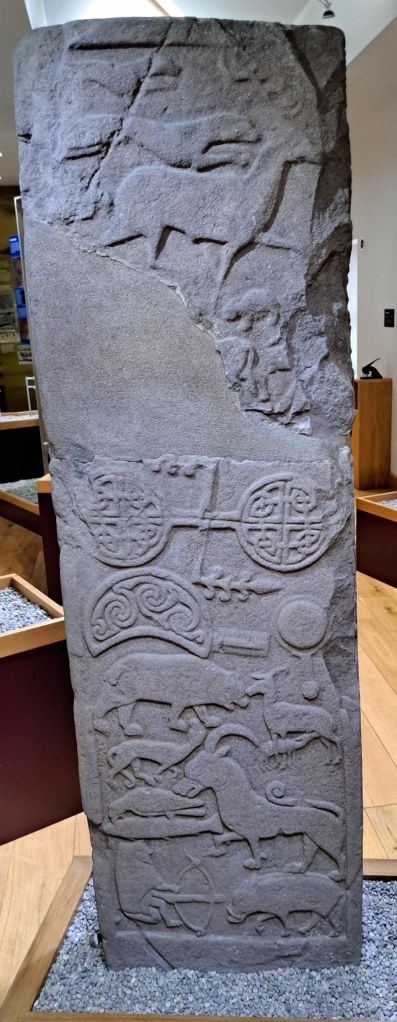
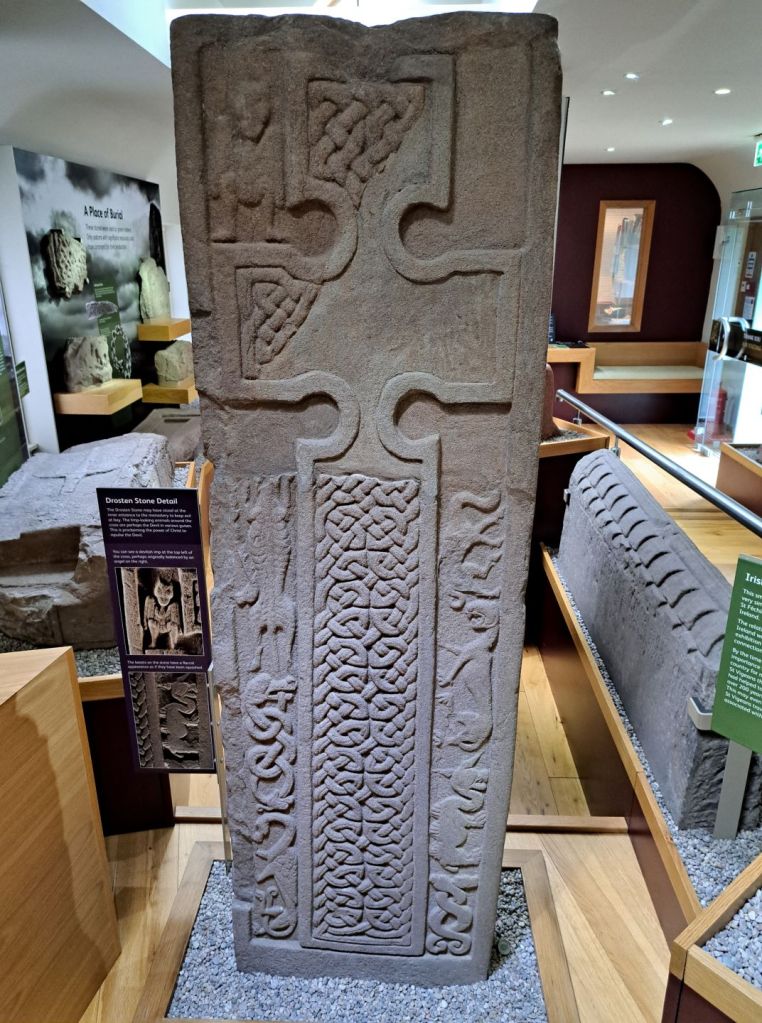
The second piece of evidence is more propositional and can be seen in the St Vigean’s museum near to Arbroath. This is the Drosten stone, a Class II Pictish monument dating from the 9th century, with a cross on one side and Pictish symbols on the other. The cross side includes a number of odd-looking creatures in odd-looking positions and also what looks like a winged devil sitting on the cross itself. The “Pictish” side shows a stag hunt, double disk and Z-rod, crescent, mirror and comb, and also a number of more normal-looking animals (a doe with her fawn, a bear, an eagle eating a salmon, a bear about to be shot by an archer) and a larger beast that looks like a goat-lion-dog hybrid.
The stone takes its name from an inscription at the bottom of one of the side panels. This seems to read as:
DROSTEN:
IREUORET
[E]TTFOR
CUS
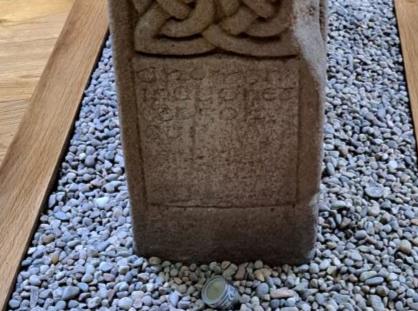
Its meaning has been much debated over the years but if we take (as I am inclined to do) the definition proposed by Thomas Owen Clancy[9], this can be read as:
DROSTEN: I RE UORET [E]TT FORCUS
This would give us “Drosten, in the reign of Uoret, and Forcus”, with Drosten – who died during the reign of Uoret (our Uurad/Ferat) – and Forcus (Fergus?) being the objects of the stone’s commemoration. Clancy also suggests another possibility, where Drosten is actually the engraver of the stone. However, for the purposes of this post, the key point is the potential reference to Uurad.
Clancy also makes the point that, should this interpretation (and therefore the date of somewhere between 839-842) be accepted, the stone is displaying evidence of Gaelic speakers deep inside Pictish territory as the midpoint of the 9th century approaches. Although the names of the king and Drosten are Brittonic/Pictish, Forcus is Gaelic. The mix of Gaelic (“i re”) and Latin (“et(t)”) is not unknown either in inscriptions or texts such as the Irish Annals.
In summary then it looks like after the catastrophic defeat by the Norse in 839, which impacted both the Picts and the Dal Riadan Scots, Uurad ruled in Pictland for three years, and was based around Perthshire. It is frustrating that we have no reference to him in the Annals: it would have been interesting to see whether he was referred to as king of the Picts or of Fortriu, perhaps adding further insight into the debate about where exactly that kingdom lay. However other evidence is enough to prove his existence. His son, Bred, then ruled for one year but for those who followed, the truth becomes murkier, not helped – as we shall see – with the tales that would grow up around a king who was probably already in power in Dal Riada and who would also extend his rule to encompass the Picts: Cináed mac Ailpin.
[1] See Dauvit Broun in “Pictish Kings 761-839” (“The St. Andrews Sarcophagus”, edited by Sally M Foster, page 82) who illustrates how Onuist II might have been a grandson or grandnephew of Onuist I
[2] Further details can be found in previous posts within this blog
[3] MS BIB FAC JURID EDIN 34.7.3 (1187) quoted on page 150 of Skene’s Chronicles as “Chronicle of the Scots and Picts MCLXXXVII”
[4] MS BRIT MUS HARL 4628 (1251) quoted on page 173 of Skene’s Chronicles as “Chronicle of the Picts and Scots MCCLI”
[5] MS SIR T PHILLIPPS No 3119 (1317) quoted on page 287 of Skene’s Chronicles as: “Chronicle of the Picts and Scots MCCCXVII”
[6] “Irish Version of the Pictish Chronicle” MS TRIN COLL DUBL H.3.17 quoted on page 400 of Skene’s Chronicles
[7] For consistency and to differentiate from the son of Fodel/Fetal/Fokal, I will use the name Bred throughout this post
[8] Recorded in Skene’s Chronicles, page 188, and available here
[9] See (PDF) The Drosten Stone: a new reading by Thomas Owen Clancy

 The Northern Tapestry
Leave a comment