
In the year 839 the Annals of Ulster tell us about an important battle in which the Vikings defeated the Picts:
“Bellum re genntib for firu Fortrenn in quo ceciderunt Euganan m. Oengusa ⁊ Bran m. Oengussa ⁊ Ęd m. Boanta ⁊ alii pene innumerabiles ceciderunt.”[1]
(The heathens won a battle against the men of Foirtriu, and Eóganán son of Oengus, Bran son of Oengus, Aed son of Boanta, and an almost uncountable number of others perished.)
The heathens are of course the Scandinavians – the Vikings – who had continued to menace the British Isles in the 830s, while laying down more permanent foundations there. Although the text contains no further details about the three men named, it is clear that they have been singled out for good reason. The first two are Pictish royalty, while Aed is a Dal Riadan king.
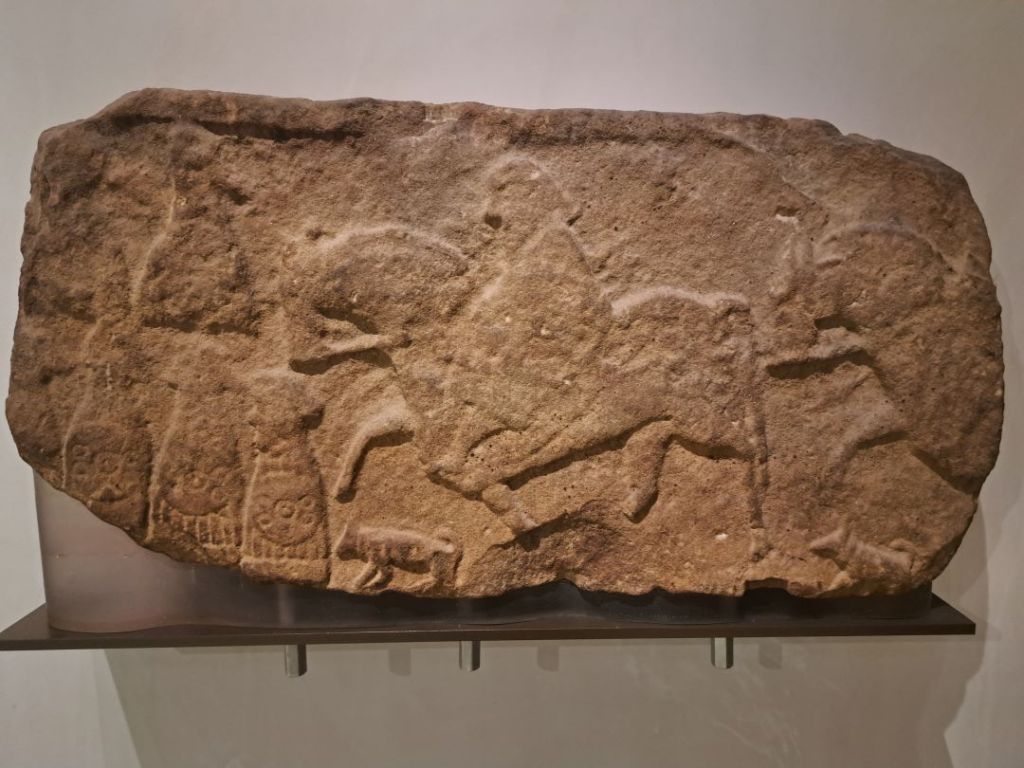
Eóganán son of Oengus is also know as Uuen – or Wen – son of King Onuist II, whom we have met before (see in particular Onuist II and the Flag of Scotland). Onuist had died in 834[2] and it looks like he was succeeded by his nephew Drest. The uncertainty arises as we have nothing in the Irish annals about this so have to rely on the Pictish King Lists[3] which state that on the death of Onuist:
“Drest filius Constantini, et Talorgen filius Vuthoil iij annis conregnaverunt”
(Drest, son of Constantine and Talorgan, son of Vuthol reigned together for three years)
Constantine is Onuist’s brother (and predecessor as king), and the family’s grip on power continued although we have no other information about his co-ruler Talorgen, nor Talorgan’s father. If the dates are to be believed, then this arrangement lasted until 837 when Eóganán (or Uuen/Wen), the brother of Bran, took over. The king lists state that Uuen also reigned for three years[4] thus extending the family’s rule a little bit longer until his death, as reported in the Annals for the year 839.
In summary then, we have as Pictish kings:
- 789-820: Constantin, son of Uurguist
- 820-834: Onuist, son of Uurguist
- 834-837: Drest son, son of Constantin and Talorgen, son of Vuthoil
- 837-839: Uuen, son of Onuist
The third person mentioned in the Annals of Ulster 839.9 is Aed son of Boanta and it is highly likely that he is the figure mentioned in the Duan Albanach and also the Synchronisations of Flann Mainistreach.
The Duan Albanach or “Song of the Scots” dates from the last half of the 11th century and as well as containing the mythological origins of the Gaels, recorded the names of the “Scottish kings” (see also Kings in the North)[5]. This states that the “noble Aed” ruled for four years (cethre bliadhna Aodha áin), which would start his reign in 835 – just after Domnall died.
The 11th century Synchronisms[6] lists Aed as a king of Alba, following the Pictish kings Domnall mac Custantin, Custantin mac Fergusa, and Aengus mac Fergusa. Putting aside the obvious problem in the order (with Domnall being listed before his father and uncle, this does seem to hint at Pictish hegemony over Dal Riada, and in Constantin, son of Uurguist/son of Fergus I suggested that Domnall ruled over those lands under the aegis first of his father then his brother, both kings of Picts This would suggest that when Domnall died, the Scots managed to regain some of their lost power, and this could have been in 835 with Aed.
Meanwhile the Scandinavian attacks on the British Isles had continued.
In The Roaring ’20s (the 820s) I noted that by the 820s it was clear that in Ireland
“the visiting Northmen were not just setting up camp for the duration of their stay but were also spending longer periods of time there and would start to settle on a more permanent basis. The earlier time-limited raiding episodes continued but they were now also giving way to more frequent pitched battles against defending armies.”
This pattern continued into the 830s where, according to the Annals, the intensity of clashes seems to have increased.
In 831, Armagh was attacked three times in one month by “the heathens” and the community there defeated with many captives taken, probably into a life of slavery[7].
The following year saw the plundering of Duleek and the people of Keenaght with all their churches[8]. Churches in Louth, Muckno, Omeath and Druim Ublae (possibly in County Louth) also suffered this treatment[9]. The shrine of Adomnan, the former Abbot of Iona (and biographer of Columba) was stolen from Donaghmoyne[10].
Also in 832, Raith Luirigh (Maghera) and Connor were attacked[11], although the Scandinavians suffered a defeat at the hands of Niall Caille and Murchadh at Derry “where a slaughter was made of them.”[12]
In 833, Lismore, Kilmolash[13], Clondalkin[14] and Dromiskin[15] were plundered – the latter was burned, but in 834 the Irish inflicted another defeat on the “heathens”, led by Dunchad son of Scannlan, king of Ui Fidhgeinte[16].
834 saw Glendalough attacked along with Slane and Finnubair Abae (near Slane?)[17] as were Ferns, Clonmore, Dromin, Mungret and other churches in Ormond[18].
An entry for 836 (probably) is interesting:
“Kildare was plundered by heathens from Inber Dea[19], and half of the church was plundered.”
This might suggest that the northmen had established some sort of permanent or semi-permanent position in Ireland, from which they could launch attacks.
On Christmas Eve 836, Clonmore was burned with many casualties and prisoners taken. The oratory of Glendalough was also burned while the whole of Connaught was devastated[20]. Of interest here is the date. As well as the effrontery of a Christmas attack, it looks likely that the “heathens” were overwintering nearby.
The locations highlighted above and below show that the interior of Ireland was also now likely to suffer as well as the coastal areas which had been the main zone of interest for earlier assaults, again suggesting that the raiders were starting to settle.
In 837 a fleet of sixty ships was seen on the River Boyne and a second fleet – also of sixty ships – on the Liffey[21]. The Annals seem clear that these were separate fleets. An Irish victory by the men of Brega at Mughdhorna Breagh (perhaps in Monaghan or Meath?)[22], where sixty score (120) vikings were slaughtered, was followed by a defeat by the invaders at Inber na mBarc, in County Cork[23]. In this second battle the number of people killed is said to have been uncountable and without precedent[24].
In this year we have the first record of a name: Saxolb, described as leader of the foreigners, is reported to have died at the hands of the Ciannacht[25].
In 838 the men of Connaught were defeated[26] and in 839 the foreigners set out on campaign of violence from Lough Neagh[27]. Again this points to some sort of base, from which they launched attacks on the churches and people of the north of Ireland. Ferns and Cork were also burned that year[28].
The summary of relentless battles, burning, plundering, slaughter and slavery above does not necessarily mean that Ireland suffered more than its neighbours. It could be that we simply have more records for that land.
There was certainly ongoing fighting elsewhere in Britain. The Anglo-Saxon Chronicle’s entries for the 830s are largely confined to similar activity further south with the overrunning of the Isle of Shepey (832), battles against “Danes” in Wessex (833, 835) and Portland (837)[29] – and possibly the reference to a great slaughter in London, Canterbury and Rochester in 839[30]. Unfortunately the Chronicle omits any mention of the northern Anglo-Saxons at this time, other than a reference in the year 827, where the Northumbrians pay homage to the powerful King Egbert of Wessex[31]. The king there at this time would have been Eanred, son of Eardwulf who had reigned at the turn of the century (and had risen from the dead), as set out in The Roaring ’20s (the 820s):
- 796: Oswald (reigned for 27 days)
- 796-806: Eardwulf
- 806-808: Ælfwald
- 810-840: Eanred
The literary sources for the Northumbrian kings at this time are scarce and we rely on later accounts, particularly Symeon of Durham and Roger of Wendover, for these dates. However numismatic evidence might suggest that Eanred’s reign lasted a little longer than the dates above[32], perhaps into the 850s.
This then was the position of northern Britain and Ireland when the vikings defeated an army of Picts and Scots, killing two kings in the battle in 839. Unfortunately we have no further details relating to this, although Alex Woolf acknowledges the temptation to suppose that it took place “in the heart of Fortriu on the shores of the Moray Firth[33]” while an earlier study suggested that the attack “penetrated the Earn and Tay valleys in the heart of the Pictish kingdom…somewhere in Strathearn”[34]. Wherever the location, its impact would be felt in the years to come. The house of Onuist was no more and the leadership of the Picts faced a crisis. After centuries of the Picts and Scots living alongside each other, one sometimes overshadowing the other and their affairs become ever more intertwined, things were about to change.
Meanwhile, in Scandinavia[35]
In the area of Møre in what is now western Norway, far from the turmoil and slaughter in the British isles being caused by his countrymen, a young boy approaching adulthood has just learned that his mother is pregnant. The boy, Rognvald, is as yet the only child of his parents and the gap between his birth and what will turn out to be his brother the following year will be around ten years. His father is Eystein Glumra (“the noisy” – because he never shuts up, according to his friends), one of the more important men in the area. Not quite a king, but certainly one of the many who would willingly vie for that position if the various areas and rulers of the country were ever united.
Not too far from where he is perhaps practising his swordplay, or maybe learning some other craft, a girl of a similar age is doing what young girls of around ten years of age did then. This might be finessing her house duties: cooking, cleaning, sewing or looking after the animals. However in this case, the girl, who is called Auðr, is also from a prominent family, and her intelligence and strength has been noted by her family and friends. She is perhaps one of the few girls who are taught how to use a sword. Her father – mentioned in The Islands of Sheep: Settlement of The Faroes and The Roaring ’20s (the 820s) – is Ketill, known for obvious reasons as “Flatnose.”
News of the battle of 839, and their compatriots’ victory, will soon reach the communities of these two youngsters and the ears of both of their fathers, stirring an interest which will have important consequences both for them personally and for the future story of the lands across the sea to the west.
[1] Annals of Ulster 839.9
[2] Annals of Ulster 834.1: “Oengus m. Fergusa, rex Fortrenn, moritur”
[3] For an online version, see THE PICTISH CHRONICLE (archive.org)
[4] “Uven filius Unuist iij. annis regnavit.”
[5] An online version in the original can be found within “The Irish version of the Historia Britonum of Nennius” here, with a translation here. You can find the texts in section IV of the Appendix.
[6] Quoted in “Chronicles of the Picts, Chronicles of the Scots, and Other Early Memorials of Scottish History” by William Forbes Skene, page 21
[7] Annals of Ulster (AU) 831.7 & 832.1; Annals of the Four Masters (A4M) 830.2; Chronicon Scotorum (CS) 832.1
[8] AU 832.3; A4M 830.3; CS 832.3
[9] CS 832.2; A4M 830.4
[10] CS 832.4; AU 832.5
[11] AU 832.6; A4M 831.3
[12] A4M 832.4; CS 833.1
[13] CS 832.7; Annals of Inisfallen 833.1
[14] CS 833.2; AU 833.5
[15] AU 833.11
[16] AU 834.8; CS 834.4; A4M 833.9
[17] A4M 833.10; AU 834.9; CS 834.5
[18] AU 835.5; A4M 834.8
[19] Unknown, but possibly on the coast near Arklow
[20] CS 836.4; A4M 835.10
[21] A4M 836.10; CS 837.2
[22] CS 837.3; A4M 836.11
[23] A4M 836.12; CS 837.4
[24] “dú in ro ládh ár nat r-airmhędh riamh” and “dú ra laeedh ár nár hairmedh riamh”
[25] CS 837.6; A4M 836.16; AU 837.9
[26] A4M 837.13
[27] AU 839.7; A4M 838.10; CS 839.2
[28] AU 839.10; A4M 838.11; CS 839.3
[29] Anglo-Saxon Chronicle for the years 832-837
[30] Anglo-Saxon Chronicle for the year 839: “Her wæs mycel wælsleht on Lundene 7 on Cantwic 7 on Rofescæstre.”
[31] Anglo-Saxon Chronicle for the year 827 – although this probably took place a couple of years later as the passage in question also refers to a lunar eclipse that is dated to 829
[32] See Northumbrian Numismatic Chronology in the Ninth Century by H.E. Pagan (1969)
[33] “From Pictland to Alba: 789-1070” (2007) page 66
[34] “Viking Empires” by Angela Forte, Richard Oram and Frederik Pedersen (CUP, 2005), page 81. This book was written at a time when Fortriu was still largely thought to be based around Perthshire.
[35] This section is largely guesswork, based mainly on Icelandic sources, but I hope that it presents a narrative that is possible. The story of Rognvald and Auðr will be continued in later posts

 The Northern Tapestry
Leave a comment