
My recent article, Kings in the North, noted that at the time of the first “Viking” onslaught (see also Arrival of the Northmen), Constantin son of Uurguist was the king of Picts while there was less certainty around what was happening in Dal Riada. A little further south in Northumbria, Aethelred, son of Aethelwald Moll, had reclaimed the throne there in 790 after a break of some eleven years.
This post will now look at Constantin and try and make sense of what was happening in this area as the eighth century was replaced by the ninth.
Constantin is first mentioned in the Annals in 789 as the victor in battle over the then Pictish king Conall, son of Tadc:
“Bellum inter Pictos ubi Conall m. Taidhg uictus est ⁊ euassit; ⁊ Constantin uictor fuit.”
(A battle between the Picts in which Conall son of Tadc, was defeated but escaped; Constantin was the victor[1])
The Annals then have no further information about Constantin until his death in 820, but we have other albeit limited sources available.
The Pictish King Lists place him after Conall, noting that he reigned for xxxv (35) years[2]. This figure is repeated in the Irish and Pictish Additions to the Historia Brittonum.[3]
However as stated above, the Annals, which are generally more reliable than the other sources, noted that he died in 820, which at most could be determined as 32 years after his defeat of Conall. It is of course possible that this battle took place in the second of third year of his reign meaning that his time in power could have begun early than is usually thought. Another solution could be a simple transcription error – xxxv instead of xxxii – which was then repeated through the ages.
Other later sources, the Duan Albanach[4] and the Synchronisms of Flann Mainistreach[5], also mention Constantin but note that he ruled – in Dal Riada – for nine years[6] The Synchronisms call him Custantin mac Fergusa, with Fergus being the Gaelic version of Uurguist.
So what is going on here? Is this evidence that the Picts once again were overlords of the Dal Riadan “Scots”?
There is debate about the ancestry of Constantin. Some scholars have argued that his father was a royal Gael: Fergus, son of Echdach who reigned in Dal Riada from 778 until 781. Therefore his capturing of the Pictish throne can be seen as part of a Dal Riadan takeover of Pictland, although he may have had a Pictish mother. However, as mentioned in Kings in the North, the vanquished Conall fled to Dal Riada and later became king there (around 805). This exchange of kings between the two peoples seems unlikely.
More recently others have argued that the takeover was the other way round, i.e. that it was the Picts who were still calling the shots in the west as well as the east, much as they had done so in the time of Onuist I, the king who died in 761, and in fact that Constantin was a member of the earlier king’s dynasty. After all, both of their fathers were called Uurguist and Constantin’s brother (of whom more in a later post) was called… Onuist.
While, as ever, much of this is conjecture, it is worth reflecting on Thomas Clancy’s short article called “Iona in the time of the Picts”[7] that points out that a German poet, Walahfrid Strabo, writing contemporaneously about a Viking attack on Iona in 825 describes that holy place as “insula Pictorum”, or island of the Picts. The article argues that this supports the view that the kings of the Picts, Constantin and then his brother Onuist, had exerted dominion over Dal Riada.
The sources suggest that Constantin had (at least) two sons. The first of these, Drest, is mentioned in the Pictish king lists (he will later reign from around 834-7). The second comes from the “Scottish” sources. The Synchronisms list him simply as “Domnall mac Custantin” while the Duan Albanach has a short but more interesting description:
“A ceathair ficheat, nír fhann, do bhliadhnaibh do chaith Domhnall”
(“Twenty-four years reigned Domnhall, no imbecile”)
As mentioned above, the chronology of kings at this time is very confusing but it seems likely that Domnall’s twenty-four years took place between 811 and 835. Donncoirce, mentioned in Kings in the North, died in 792[8] and after that we have little idea who was in charge until Conall son of Tadc took over around 805. Conall was then killed by another King Conall (son of Aedain) in Kintyre in 807[9]. These years of uncertainty, with their paucity of records, do of course coincide with the first wave of attacks and invasions from Scandinavia.
Could it be the case then that with Constantin ruling Pictland, one of his sons took over Dal Riada in 811 and therefore father and son ruled the north between them until Constantin’s death? This would make sense of the Duan Albanach while also fitting in with the Annals.
In summary then, my preferred reconstruction is as follows:
- Constantin acceded to the Pictish throne around 789, expelling Conall son of Tadc. After an initial period of conflict with the “vikings”, which affected the Dal Riadan West rather than the Pictish East[10], Conall found himself as lord of Dal Riada (805-807) before being ousted by Conall son of Aedain who lasted until 811.
- In 811 Constantin’s son Domnall gained control over Dal Riada and this continued until Constantin’s death in 820. Constantin’s appearance in the “Scottish” records is possibly a later addition with the benefit of hindsight in the future Alba/Scotland.
- The dynasty remained in charge with Onuist, brother of Constantin, ruling in Pictland until his death in 834.
- Domnall’s reign over Dal Riada lasted until he passed away in 835 – but we are getting ahead of ourselves and there will be more on this in a future post.
Constantin died in 820, peacefully it would seem, and his brother Onuist succeeded him in Pictland while his son continued to run Dal Riada. Before we leave him, there are four other things to mention.
Firstly it should not go unnoticed that his name was not Pictish, Gaelic, British nor Anglo-Saxon. This was a name which would later be used by royalty in Pictland and Scotland and was a reference to the early 4th century Roman Emperor Constantine who was the first in that role to convert to Christianity. Our Constantin is not the first recorded use of the name in Britain. There seems to have been two British kings known: the first in 6th century Dumnonia in south-west England; the other in Strathclyde who is said to have reigned in the late 6th and early 7th centuries.[11]
Secondly within St Serf’s Church in Dunning can be found the beautiful carved stone known as the Dupplin Cross. This was originally set out in the open near the royal Pictish lands of Forteviot and is a free-standing red sandstone cross with intricate details which are mostly still visible. Barely legible however is an inscription which reads: CUSTANTIN FILIUS FIRCUS – a Latinised-Gaelic reference to this king of the Picts (and overlord of Dal Riada?).
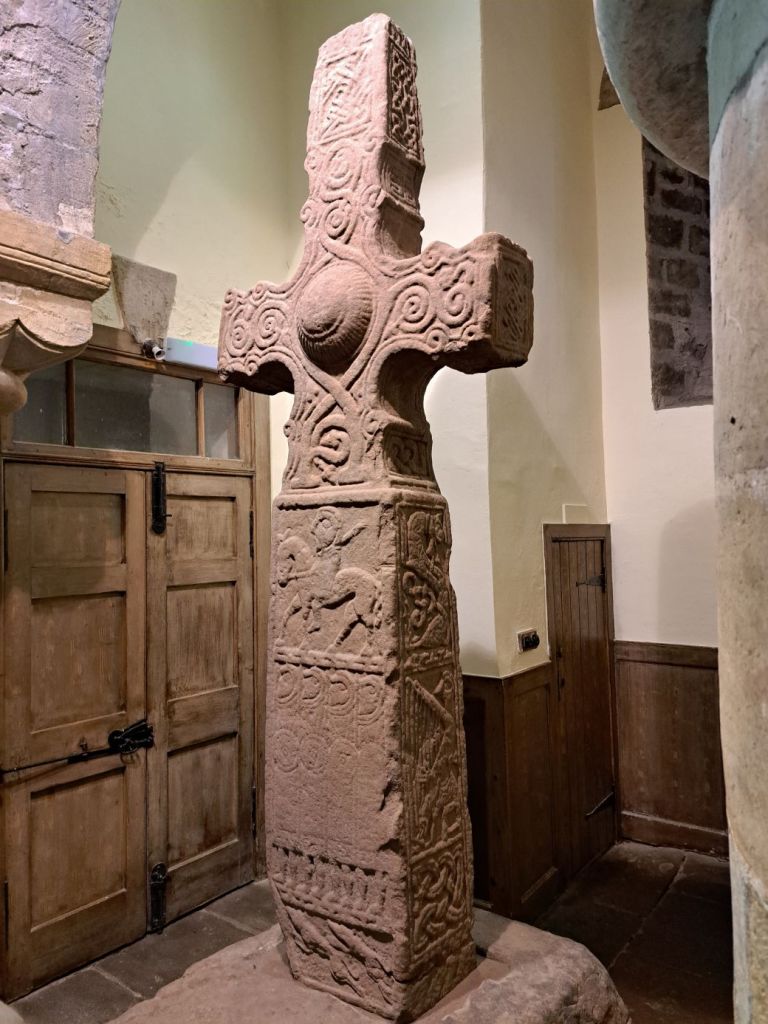
Thirdly, in a very confused Pictish king list in John of Fordun’s Chronicle (dated to the late 14th century), we have:
“Constantinus filius Fergusa 42 annis. Hic aedificavit Dunkelden”
(“Constantine, son of Fergus ruled for 42 years. He built Dunkeld.”)
Just north of Perth (and about the same distance again to royal Forteviot), Dunkeld, “fort of the Caledonians” was an important religious site which would later house the relics of St Columba
Finally the name “Custantin” appears in the “Nomina Regum vel Ducum” (names of kings or leaders) section of the Durham Liber Vita. This book, dating from around 840 and possibly produced at Lindisfarne, records the names of visitors and patrons of the church in Northumbria. The rarity of the name (and especially one attached to a king or leader) has led to this Pictish king being the person identified here.
All of these links suggest a close connection of a major political figure to the church in northern Britain. What a pity the sources lack any further details of Constantin, son of Uurguist.
[1] Annals of Ulster 789.11
[2] “Castantin filius Vurguist xxxv. annis regnavit.”
[3] “Cuastantin, fil. Uurguist, xxxv.”
[4] This “Song of the Scots” dates from the last half of the 11th century and as well as containing the mythological origins of the Gaels, recorded the names of the “Scottish kings”, including those featuring here from Dal Riada
[5] 11th century Irish poet and historian
[6] Duan Albanach: “Naoi m-bliadhna Cusaintin chain” (The nine years of Cusaintin the fair)
[7] Iona in the kingdom of the Picts: a note (gla.ac.uk)
[8] Annals of Ulster 792.4; Annals of the Four Masters 787.12
[9] Annals of Innisfallen 807.2; Annals of Ulster 807.3
[10] Note the possible scenario reported by Woolf of collusion between the Vikings and the Picts, as outlined in Arrival of the Northmen
[11] Although it is sometimes thought that these two were the same person

 The Northern Tapestry
Leave a comment