
The portentous weather and astronomical events we looked at in Bad Weather, Bad Omens continued into the last decade of the 8th century with what is perhaps the most infamous of all happening in the year 793. Recounted in a number of sources[1] the gist is that there were flashes of fire in the skies above Northumbria, accompanied by whirlwinds and flying dragons – and all followed by plague and famine.
Whatever you may think about the existence of dragons, what happened next was very real:
“On the eight of June in the same year, the harrowing attacks by heathen men resulted in lamentable havoc in the church of God on Lindisfarne, by plunder and slaughter.”[2]
“That same year, the pagans from the Northern region came with a naval army to Britain, like stinging hornets, and overran the country in all directions, like fierce wolves, plundering, tearing, and killing not only sheep and oxen, but priests and Levites, and choirs of monks and nuns. They came, as we said before, to the church of Lindisfarne, and destroyed everything with terrible havoc, stomped on the holy places with their unholy feet, dug up the altars, and carried off all the treasures of the holy church. They killed some of the brothers; others they carried off in chains; many they cast out, naked and insulted; some they drowned in the sea.”[3]
“Then the atrocities of the heathen race and the Norwegians, who in the same year destroyed the monastery of Lindisfarne, killed the monks, and smashed Northumbria with a terrible destruction.”[4]
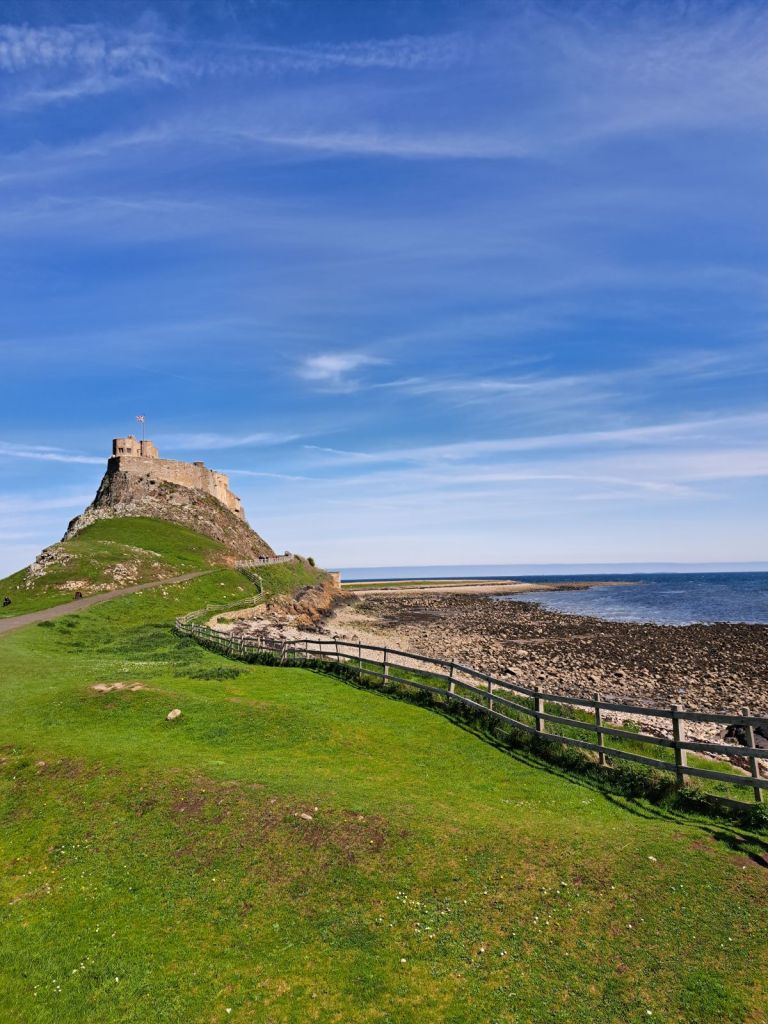
This attack of 793 is often taken to be the first on the inhabitants of the British Isles and indeed is often given the honour of heralding the start of the “Viking Age.” However, there are reports of an earlier event much further south and recorded in the Anglo-Saxon Chronicle for the year 789:
“This year King Bertric married Edburga the daughter of King Offa. And in his days there came first three ships of the Northmen from the land of Hordaland. The King’s reeve then rode there and wanted to take them to the king’s town; for he was unaware of who they were; and there was he killed. These were the first ships of the Danish men that sought out the land of the English.”[5]
A later document called the Chronicon Æthelweardi, believed to be a Latin translation of a lost version of the Anglo-Saxon Chronicle, notes that this town is actually Dorchester and that the reeve was called Beaduheard. The landing place of these “pagans” is generally taken to be Portland, which is qround 15 miles south of modern-day Dorchester in Dorset.
We also have evidence from an Anglo-Saxon Charter that suggests King Offa was well aware of the threat from overseas before the attack on Lindisfarne. This Charter, granting certain privileges to the churches of Kent in 792 provides for exemptions for those churches “except in an expedition within Kent against the pagan sailors with their roaming fleets, or against the southern Saxons, if required, and the construction of a bridge and the fortification of a castle against the pagans.”[6]
The record of the Portland episode of 789 mentions that the attackers came from Hordaland, an area in what is now Norway. The lack of literary evidence from Scandinavia at this time means that we have nothing like a Norwegian version of the Irish Annals. We know for example of a Danish king from around this time called Gudfred (or Guðfrið, Godfred, Göttrick, Gøtrik, Gudrød, Godofredus, etc) who possibly rebuilt the Danevirk, a defensive barrier (walls and trenches) which protected southern Scandinavia from the Germanic peoples to their south[7], and later records (much later and mostly to originate in the as yet “undiscovered” Iceland) allow us to work backwards to these decades in the search for personalities – as I tried to do in A Very Short Interlude Across the North Sea. In time that position will change, but for the last years of the 8th century, our records of individuals from the north are very limited.
These raiders from the north have become known as the Vikings although the term is best used to describe what they did rather than what they were: it was a professional description rather than an ethnic label. Many words have been written to try and explain the reasons for the overseas raiding. No doubt the silver and other treasures stolen from British and Irish monasteries will have been attractive but perhaps the biggest reason for the attacks was the promise of slaves. These slaves could then be transported back to Scandinavia (or wherever their captors had settled) and used instead of paid labour, or exchanged for other goods along the extensive trading routes to the south and east of the European continent.
The depiction of Lindisfarne is often as a “one-off attack”, sometimes as in the TV Series Vikings, (where well-known Vikings Ragnar Lothbrok and his brother Rollo lead the charge), where the Norsemen are joyously surprised at what they find (definitely mixing up too many stories there![8]).
The Historia Regum goes on to tell us that the raiders of 793 got payback the following year, suggesting they stayed put over winter:
“The previously mentioned pagans, destroying the harbour of king Ecgfrid, plundered the monastery at the mouth of the river Wear. But St. Cuthbert did not allow them to leave without punishment; for their chief was there put to a cruel death by the Angles, and after a short time a violent storm shattered, destroyed, and broke up their ships, and many were consumed by the sea; some, however, made it to the shore but they were soon killed without mercy : and these things happened to them justly, since they seriously injured those who had not injured them.”[9]
The Annals also tell us that the raid were more widespread in the coming months and years:
- 794: “Devastation of all the islands of Britain by heathens”[10]
- 796: “The first coming of the gentiles among the southern Irish.”[11]
- 796: “The burning of Inis Pátraic by the heathens, and they took the cattle-tribute of the territories, and broke the shrine of Do-Chonna, and also made great incursions both in Ireland and in Alba.”[12]
- 805/6: “Iona was burned by foreigners, i.e. by the Norsemen.”[13]
- 807: “The heathens burned Inis Muiredaig and invaded Ros Cam.”[14]
- 811: “A slaughter of the heathens by the Ulaid.”[15]
And so on.
It has been suggested that the northern isles (Orkney and Shetland) had received contact from the Norsemen some time before the raiding began, or at least some time before the reports of raiding further south. There is archaeological evidence that supports this, specifically relating to antler combs found in Scotland which suggests that the Picts were importing antler from Norway.[16]
Others have suggested that the Northern Isles were a natural stepping stone to the British mainland and Ireland. This argument does have some merit and if there was already an earlier or more peaceful relationship between the Shetlanders, Orcadians and Norse, it might explain why there is no reference to raids in those islands prior to Lindisfarne. Equally it may just be that the Irish sources show a lot less interest in the affairs of the east and north after death of Onuist in 761.
This may also be the simple reason to explain one scenario presented by Alex Woolf. In his book, “From Pictland to Alba 789-1070”, he notes (p56-7) that there is no mention of attacks on Pictish territories (and specifically churches) compared with the many on the western people of (modern-day) Scotland and Ireland, and this could signal some kind of agreement between the Pictish king Constantin and the Vikings.
In future posts I will look at Constantin and his dynasty and will present more evidence from the sources of non-stop raids over the following years. This is the beginning of a relationship that will make a lasting impact on this Northern Tapestry.
[1] For example: Anglo-Saxon Chronicle, Symeon of Durham’s Historia Regum, Chronicle of Melrose
[2] Anglo-Saxon Chronicle 793: “7 litel æfter þam þæs ilcan geares on .vi. idus Ianuarii earmlice heðenra manna hergung adiligode Godes cyrican in Lindisfarenaee þurh reaflac 7 mansleht.” The month of January is generally taken to be an error for June. It is unlikely that the attackers sailed in the middle of winter
[3] Symeon: Historia Regum 793: “Eodem sane anno Pagani ab aquilonali climate navali exercitu, ut aculeati crabones, Britanniam venientes, hac illacque ut dirissimi lupi discurrentes, praedantes, mordentes, interficientes non solum iumenta, oves et boves, verum etiam sacerdotes, Levitasque, chorosque monachorum atque sanctimonialum, veniunt, ut praefati sumus, ad Lindisfarnensem ecclesiam; misreabili praedatione vastant cuncta, calcant sancta pollutis vestigiis, altaria suffodiunt, et omnia thesauraria sanctae ecclesiae rapiunt. Quosdam e fratribus interficiunt, nonnullos secum vinctos assumunt, perplurimos opprobiis vexatos nudos projiciunt, aliquos in mare demergunt.”
[4] Chronicle of Melrose 793: “deinde sevicia gentis paganorum et Norwagensium, qui eodem anno Lindisfarnense” monasterium destruentes monachos occiderunt et Northumbriam miserabili strage percusserunt”
[5] Anglo-Saxon Chronicle 787 (but taken to be for the year 789): “Her nam Breohtric cining Offan dohter Eadburge. 7 on his dagum comon ærest .iii. scipu Norðmanna of Hereðalande, 7 þa se gerefa þærto rad, 7 he wolde drifan to ðes cininges tune þy he nyste hwæt hi wæron, 7 hine man ofsloh þa; ðæt wæron þa erestan scipu Deniscra manna þe Angelcynnes land gesohton.”
[6] Anglo-Saxon Charter S 134 (Offa, king of Mercia, to the churches of Kent; confirmation and grant of privileges): “nisi expeditione intra Cantiam contra paganos marinos cum classis migrantibus uel in australes Saxones si necessitas cogit ac pontis constructionem et arcis munitionem contra paganos”
[7] It is now in northern Germany, in Schleswig-Holstein
[8] Lothbrok – if he existed – and Hrolf/Rollo (who probably did) were not brothers and the timescales are wrong. But it’s definitely worth watching!
[9] Symeon, Historia Regum 794: “Praedicti Pagani portum Ecgfridi regis vastantes, monasterium ad ostium Doni amnis praedarunt. Sed Sanctus Cuthbertus non sine punitione cos sinebat abire. Princeps quoque eorum ibidem crudeli nece occisus est ab Anglis, et, post exigui, temporis spatium, vis tempestatis eorum naves quassavit, perdidit, contrivit; et perplurimos mare operuit. Nonnulli itaque ad littus sunt ejecti, et mox interfecti absque misericordia. Et recte illis haec contigernut, quoniam se non laedentes graviter laeserunt.” The Wear is mistakenly called Don here
[10] Annals of Ulster 794.7: “Uastatio omnium insolarum Britannię a gentilibus”
[11] Annales Cambriae 796: “Primus aduentus gentilium . apud dexterales adhiberniam”
[12] Annals if Ulster 798.2: “Combustio Inse Patraicc o genntibh, ⁊ borime na crich do breith ⁊ scrin Do Chonna do briseadh doaibh ⁊ innreda mara doaib cene eiter Erinn ⁊ Albain.”
[13] Annals of the Four Masters 797.12: “h-I Choluimb Chille do losccadh la h-allmurachaibh .i. la Nortmanoibh.” This was not the first such attack on the island (see for example the Annals of Ulster 802.9).
[14] Chronicon Scotorum 807.3: “Losccadh Innsi Muirgdhaigh o gentibh et inradh Roiss Caim.”
[15] Annals of Ulster 811.6: “Strages gentilium apud Ultu”
[16] James Graham-Campbell and Colleen E. Batey: “Vikings in Scotland” p23

 The Northern Tapestry
Leave a comment