
The Northern Monarchies in the late 8th Century.
In the last article I looked at some of the descriptions of bad weather and bad omens from the second half of the 8th century in northern Britain. This post will look at the political landscape during that time, not an easy task with the Irish Annals seeming to lose interest in the area. They do however contain references to major events and people and, alongside other sources, including the Pictish king lists and sources from Northumbria and Wessex, we are able to make a reasonable effort to understand what was happening, at least regarding the most powerful characters of the time. What follows is an interpretation of the sources and an attempt to set out the changes in monarchy and politics in the areas now known as Scotland and northern England after 761.
Picts and Scots
Onuist, the Pictish king who had become the most powerful leader in the first half of the century, died in 761. He was succeeded by his brother Bridei of whom little is known other than that he reigned for two years. The Irish annals refer to him as the king of Fortriu[1] (Onuist was described as king of the Picts) so perhaps the previous splits in the kingdom had reappeared.
Next came Ciniod, son of Vuredach, who reigned for twelve years as “rex Pictorum.[2]” It is possible that his father was the Feradach mentioned in Picts and Gaels: The Supremacy of Onuist, Part I. That Feradach, the son of the Dal Riadan king Selbach (who reigned there in the first two decades of the century) had been captured with his brother Dumgal in unsuccessfully defending themselves from Onuist’s onslaught against the Scots. If this is true, it shows once again the links between the various royal houses.
Ciniod’s most notable reference in the Annals is due to a battle which took place in Fortriu in 768[3].His opponent was Aed, who has been identified as Aed Find, a king (“rex”) of Dal Riada. With Onuist gone, the Scots began to make moves to re-establish self-rule and Aed seems to have succeeded, reigning from at least the mid-760s until his death in 778. This was three years after the death of Ciniod of the Picts, suggesting that the battle in 768 did not result in a significant victory for either side.
After the twelve years of Ciniod (763-775), the leadership of the Picts settled on a man called Elpin for the next three and a half years. The Annals get a bit confused here, calling him king of the Saxons[4], but he appears in other sources (such as the Pictish King Lists[5] and the Irish and Pictish Additions to the Historia Brittonum[6]) as the son of Vurad. The similarity of his father’s name to that of his predecessor’s father (Vuredach) has been noted, and it is possible that the kingship was held once again by successive brothers.
By the time of Elpin’s death (779), Aed had also passed away in Dalriada (778)[7], with the Scottish leadership going to Aed’s brother Fergus until 781. During that time we are met with confusion as to what was happening among the Picts.
The order of the Pictish King lists suggest that Elpin was succeeded by a Drest, son of Talorcan, who reigned for “four or five years”. Then came Talorcan son of Onuist who reigned for two and a half years, followed by Conall son of Tarla who reigned for five years. This would suggest:
- 779-783: Drest son of Talorcan
- 783-785: Talorcan son of Onuist
- 785-789/90: Conall son of Tarla
However, there are a number of issues raised by evidence from other sources.
The Irish and Pictish Additions to the Historia Brittonum[8] state that Drest son of Talorcan reigned for only one year and that Talorcan son Onuist reigned for twelve years. This source also mentioned another Talorcan – son of Drostan – who reigned for either five or fifteen years.
Perhaps more interesting is the reference in the Annals of Ulster which notes the death in 782 of “Dub Thorlagg rex Pictorum citra Monoth” (“Black Talorc, king of the Picts this side of the Mounth”). The Mounth refers to the Grampian mountain range which has been seen as the border between the northern and southern Picts (and therefore their sub-kingdoms).
All of the sources then agree that Conall then reigned for five years.
After this period of uncertainty, there is consistency in the records that the Pictish king from around 789 was someone called Constantine (his name has various spelling in the sources), son of Uurguist (or Fergus). This change happened as the result of a battle in 789 among the Picts in which Conall was defeated by Constantine. Conall survived and will feature again later in the story. But what was happening before this? My preferred sequence is set out below and seeks to incorporate all of the various kings mentioned.
After the death of Elpin in 779, authority over the Picts was initially shared by two men: Drest son of Talorcan (in the north) and Talorcan son of Onuist. After one year Drest died or was deposed and Talorcan son of Drostan took over in the south. When “Black” Talorcan son of Onuist died in 782, Talorcan son of Drostan took control of the entirety of Pictavia, ruling there until being succeeded by Conall in 785. Once again the repetition of certain names does not help, but in summary we have:
- 779-780: Drest son of Talorcan (north) and Talorcan son of Onuist (south)
- 780-782: Talorcan son of Drest (north) and Talorcan son of Onuist (south)
- 782-785: Talorcan son of Drest (all Pictland)
- 785-789: Conall son of Tarla/Tang/Taidhg
- 789-820: Constantin, son of Uurguist/Fergus
It is likely that the father of Talorcan, son of Onuist, was Onuist the great Pictish king who had died in 761.
In Dal Riada things are no less confusing. After Aed Find’s brother Fergus died in 781[9], we hear of a king called Donncoirce who lasted until 792[10]. One source[11] does mention that Fergus was succeeded by his son Seluand, but of this person there is no further information. There is then a gap between Donncoirce and the next recorded king around the year 805 who is Conall, son of Tadg[12] – the same Conall whom Constantine had driven out of Pictland in 789. One source does list a certain Domhnall who, “no imbecile”, reigned for 24 years[13], but it is likely that this king came later – and he will be discussed in a future post.
By the year 790 therefore we have Constantine in charge of the Picts but remain unsure what was happening in Dal Riada. In the meantime, what had been happening in the south?
The following is a summary of political intrigue and the dominance of two families in Northumbria at that time.
Northumbria
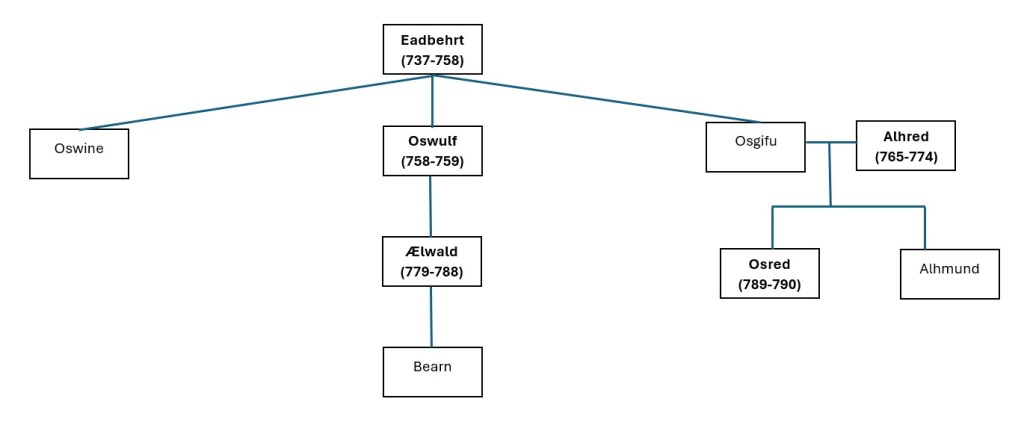
Our main source for Northumbrian history for this time is Symeon of Durham[14]. He tells us that the Northumbrian king Eadbehrt, who had joined with Onuist against the Strathclyde Britons in 756 (and perhaps then seen his army wiped out by the Picts), had entered the clerical life shortly afterwards. His successor in the year 758 was his son Oswulf – although he only lasted a year before he was “wickedly put to death by his own household,” possibly with support from the man who would then rule for around six years[15]. The terrible deed took place in the East Yorkshire town of Market Weighton.
This new king was Aethelwald Moll. However Eadbehrt’s family did not give up and Oswulf’s brother, Oswine, was involved in a battle with Moll near Melrose in 761. Moll won and Oswine was killed.
Eadbehrt, still in monastic retirement, may just have survived long enough to see his daughter Osgifu, marry the next king, Alhred. Alhred, whose ancestry apparently dated back to the original Northumbrian kings of the 6th century, had come to the throne in 765. (It had been Moll’s turn to enter the clerical life.) The wedding and Eadberht’s death both happened in 768.
This new addition to the Eadberht dynasty remained king until 774 before he was forced to flee north, first to Bamburgh and then to Pictland where he received sanctuary from Ciniod son of Vuredach whom we met earlier.
The next king was Moll’s son Aethelred who reigned twice. His first reign lasted from 774-779 and was interrupted by another member of Eadberht’s dynasty. This was Aelfwald, the son of the previous king Oswulf (and therefore Eadberht’s grandson) who reigned until 788. The Anglo-Saxon Chronicle and Symeon of Durham both report that he was murdered by a hitherto close companion, Siega, on 23rd September and also that a heavenly light was often seen there where he was killed.[16] Symeon notes that he was “a pious and upright king.”
The succession passed to another family member, Osred – son of Osgifu and Alhred – although his reign was short, ending in 790 when he entered the clerical life/was deposed in favour of Aethelred’s return.
The animosity between the two families continued. In 791 the king arranged the deaths of two sons of Aelfwald and in 792, the disgruntled Osred left his religious calling to make a final attempt to regain the throne. Osred was unsuccessful and died as a result. Aethelred was later murdered by a group of Northumbrian nobility at Corbridge in 796.
This ended the authority of Eadberht’s and Moll’s families.
A possible timeline for these kings then is:
- 737-758: Eadberht
- 758/9: Oswulf, son of Eadberht
- 759-765: Aethelwald Moll
- 765-774: Ahlred, son-in-law of Eadberht
- 774-779: Aethelred, son of Aethelwald Moll – first reign
- 779-788: Aelfwald, son of Oswulf, grandson of Eadberht
- 788-790: Osred, son of Alhred, grandson of Eadberht
- 790-796: Aethelred, son of Aethelwald Moll – second reign
Strathclyde
For Strathclyde we have much less evidence and have to rely on the Harleian genealogies, a collection of Welsh and British family lines which date back to the 12th Century. In here we find that the Strathclyde ruler Dumnagual who signed the peace treaty with Onuist and Eadberht in 756 died in battle against the Saxons[17] probably around the year 760. He was succeeded by his son Eugein, who was then succeeded by his son Riderch, then by his son, another Dumnagual. The source gives no indication of dates and since these kings have not survived in other sources, we can only assume any timescales. The next king named, Dumnagual’s son Arthgal is named in the Annals of Ulster[18] as dying in 872 so the monarchs reigning in the period up to the 790s will possibly have been the earliest of those mentioned here, although of course some names may be missing.
In summary, the reconstruction of the history of the rulers of the four northern peoples is difficult and confusing, due in part to the waning interest of the Irish Annals after the death of Onuist. The suggestions set out above are an attempt to provide some narrative to the story in the lead-up to the significant challenges which are about to arrive by sea.
[1] “Bruide, rex Fortrenn, moritur” (Annals of Ulster 763.10); “Bruidhi rí Fortrenn mortuus” (Annals of Tigernach 763.8)
[2] Cenioẏd rex pictorum obit (Annales Cambriae 776): “Eodem anno Cynothus rex Pictorum obit” (Annals of Melrose 765): “Mors Cinadhon regis Pictorum” (Annals of Ulster 775.1)
[3] “Bellum i Fortrinn iter Aedh ⁊ Cinaedh” (Annals of Ulster 768.7)
[4] “Eilpin, rex Saxonum, moritur” (Annals of Ulster 780.5) – I think this is more likely to have been in 779
[5] For an online version, see THE PICTISH CHRONICLE (archive.org)
[6] Chapter 31: Link to the online version: http://research.ucc.ie/celt/document/G100028
[7] Annals of U778.7 and Annals of the Four Masters 771.18
[8] Chapter 31: Link to the online version: http://research.ucc.ie/celt/document/G100028
[9] Annals of Ulster 781.3
[10] Annals of Ulster 792.4, Annals of the Four Masters 787.12
[11] Annals of Melrose 780
[12] Annals of Ulster 789.3
[13] Duan Albanach. This “Song of the Scots” dates from the last half of the 11th century and as well as containing the mythological origins of the Gaels, recorded the names of the “Scottish kings”, including those featuring here
[14] Most of what follows relies on Symeon of Durham, an 11th century monk and historian initially based at Jarrow before he moved to York. The years in question can be found online at Symeonis Dunelmensis Opera et collectanea. Vol. I. – Simeon (of Durham), John Hodgson-Hinde – Google Books
[15] See also Anglo-Saxon Chronicle 758: “Her Eadberht Norðhymbra cining feng to scære, 7 Osulf his sunu feng to þam rice 7 rixade .i. gear, 7 hine ofslogon his hiwan on .ix. kalendas Augusti.” (Eadberht, king of Northumbria, received the tonsure and his son Oswulf became king, ruling for one year, killed by his household on 24th July)
[16] “Her Alfwold Norðanhymbra cining wæs ofslagan fram Sigan on .ix. kalendas Octobris, 7 heofenlic leoht wæs gelome seogen ðær þer he ofslagen wæs”
[17] Annales Cambriae 320.1 and 320.2: “Bellum inter brittones et saxones . id est gueith hirford dunnagual filíí teudubr moritur” . (A battle between the Britons and the Saxons, that is the battle of Hereford in which Dyfnwal son of Tewdwr died.”
[18] Annals of Ulster 872.5: “Artghal, rex Britanorum Sratha Cluade”

 The Northern Tapestry
Leave a comment