
In the previous post about the Battle of Dun Nechtain, I noted how, according to Bede at least, Cuthbert very much opposed King Ecgfrith’s belligerent advance into Pictland – however far north into the territory that was. This follow-up post deals with a couple of related and rather eerie tales about Cuthbert and the demise of the Northumbrian king.
In his Ecclesiastic History, Bede notes that in 684, Ecgfrith had sent an army to Ireland and “miserably laid waste an innocent nation, one which had always been the friendliest to the English nation, and his hostile hands spared neither churches nor monasteries.”[1]
The following year the King, against the protests of his friends, and especially Cuthbert of Blessed Memory[2], rashly led his army to destroy the land of the Picts.
Bede (and by relay, Cuthbert) clearly though that such wickedness led to the outcome of defeat and death.
Separate texts on the Life of St Cuthbert (one of which is also assigned to Bede’s authorship) give more colour and drama to the story.
Cuthbert had become the Bishop of Lindisfarne in 684, probably aged around 50. He had been raised near Melrose in what is now the Scottish Borders but was then very much part of Anglo-Saxon Northumbria. Initially reluctant to become Bishop, he had only been persuaded to take on that role after the intervention of King Ecgfrith. Jarring with his reputation in this blog and elsewhere as a foolhardy warmongerer, the King came from a deeply religious family. His father, King Oswiu, had made a promise to God in which, should he succeed in defeating his Mercian enemy Penda, he would give up his daughter to be consecrated to the service of the Almighty in perpetual virginity. After Oswiu’s wish came true, the young girl, Ælflædd then aged 1, was entrusted to the care of Abbess Hilda in Hartlepool Abbey. Later she would follow Hilda to Whitby Abbey, eventually succeeding her as Abbess there.
Ælflædd was well-acquainted with Cuthbert. Before his elevation to the position of Bishop of Lindisfarne, Cuthbert had been Prior there. He had in fact “retired” in 676 and had entered a life of solitude. Ælflædd was one of few people who could persuade him to occasionally come out of isolation to meet her. She was a princess after all, and after 664, sister to the King.
The sources, written shortly after Cuthbert’s lifetime, tell of how the princess had suffered a serious illness, which had almost killed her. She survived but looked destined to remain crippled until a linen girdle tuned up in the post. This had come from Cuthbert who had perhaps heard her wish that if only she had something of his in her possession, all would be well. She put it on and next morning she woke up completely healed. A couple of days later, one of Ælflædd’s nuns started to suffer from headaches that were so severe she was expected to die. The princess told the nun to wrap the girdle round her head, which she did, and of course made a full recovery. The girdle then disappeared – apparently to ensure that it didn’t fall into the hands of thew wrong people.
In 684, Ælflædd sent for Cuthbert as she had an important matter to discuss with him. When he arrived at the agreed meeting place (Coquet Island, just off the Northumbrian coast and opposite modern-day Amble), she beseeched him in the name of God to tell her how long her brother would live and who would replace him. As with all seers, Cuthbert’s answer was indirect, but in this case its meaning was obvious:
“O ancilla Dei, numquid non parvum est, licet aliquis vivet duodecim menses?”
(O nurse of God, is a man’s life not short if he should not live for twelve months?)
Sure enough, within a year, the Battle of Dun Nechtain took place.
There is one final tale connecting Cuthbert to the events of 20 May 685. With his advice to the King ignored, Cuthbert took himself off to Carlisle where Ecgfrith’s second wife, Queen Iurminburh (or Eormenburg) had arranged to stay while her husband went off to war. While there Cuthbert was given a tour of the old Roman town (Luguvalium had been an important Roman settlement, both prior to and after the building of Hadrian’s Wall which crosses through the modern city), including a Roman fountain built “in a wonderful way.”
At that point Cuthbert leaned on his Bishop’s staff and stared sadly at the Roman walls. He then stood up straight and groaned:
“0,0,0! existimo enim perpetratum esse bellum, judicatumque esse judicium de populis nostris bellantibus adversum.”
(Oh, Oh, Oh! – the war is over and the judgement is against our people”
The next day a fugitive from the battle arrived back (to where isn’t clear: Carlisle?) and announced that Bede’s vision had been correct. Ecgfrith had been killed on that very day and at that very hour.
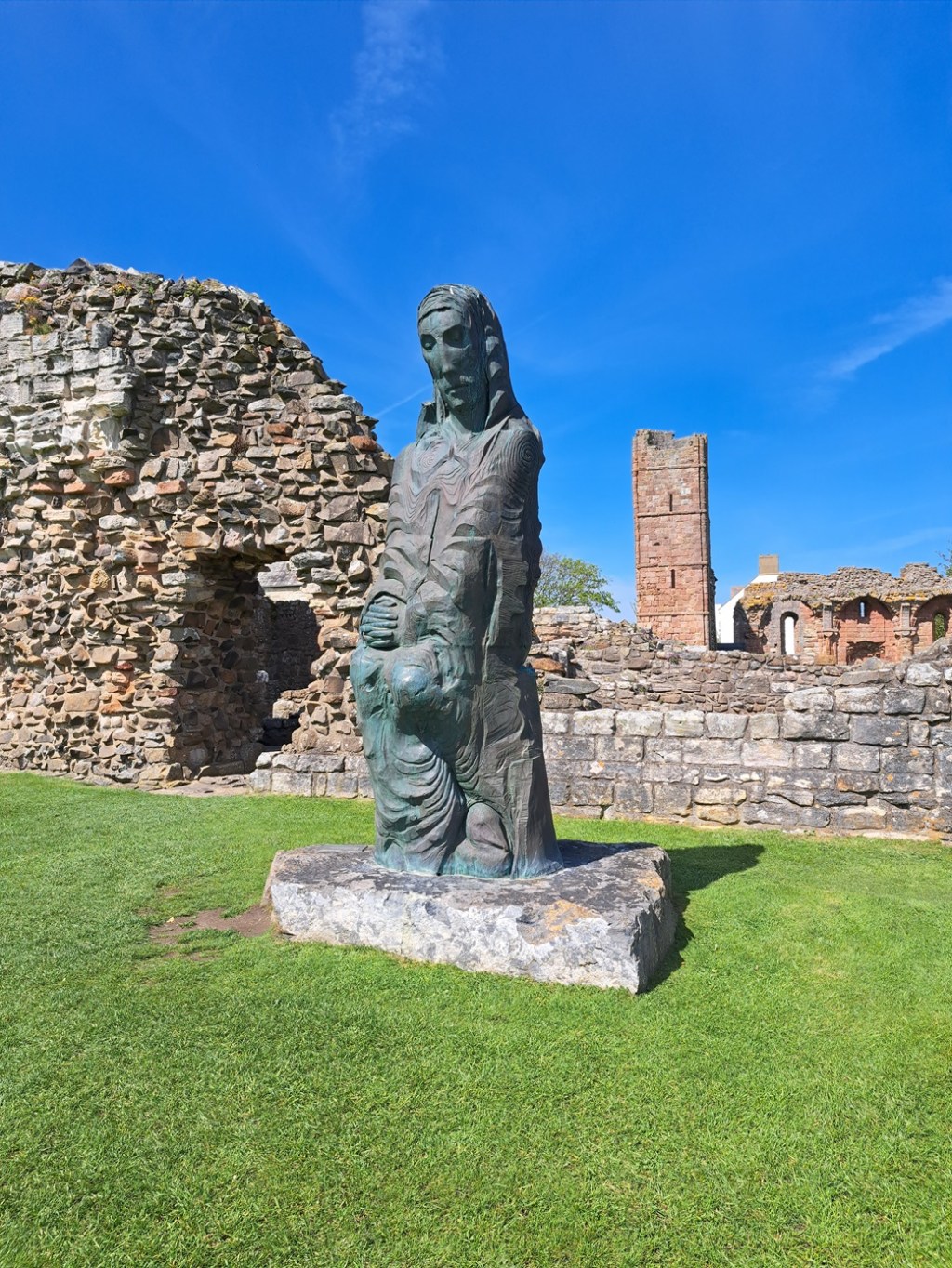
The picture shows the statue of St Cuthbert at Lindisfarne Priory
[1] “uastauit misere gentem innoxiam, et nationi Anglorum semper amicissimam, ita ut ne ecclesiis quidem aut monasteriis manus parceret hostilis”
[2] “et maxime beatae memoriae Cudbercto”

 The Northern Tapestry
Leave a comment