
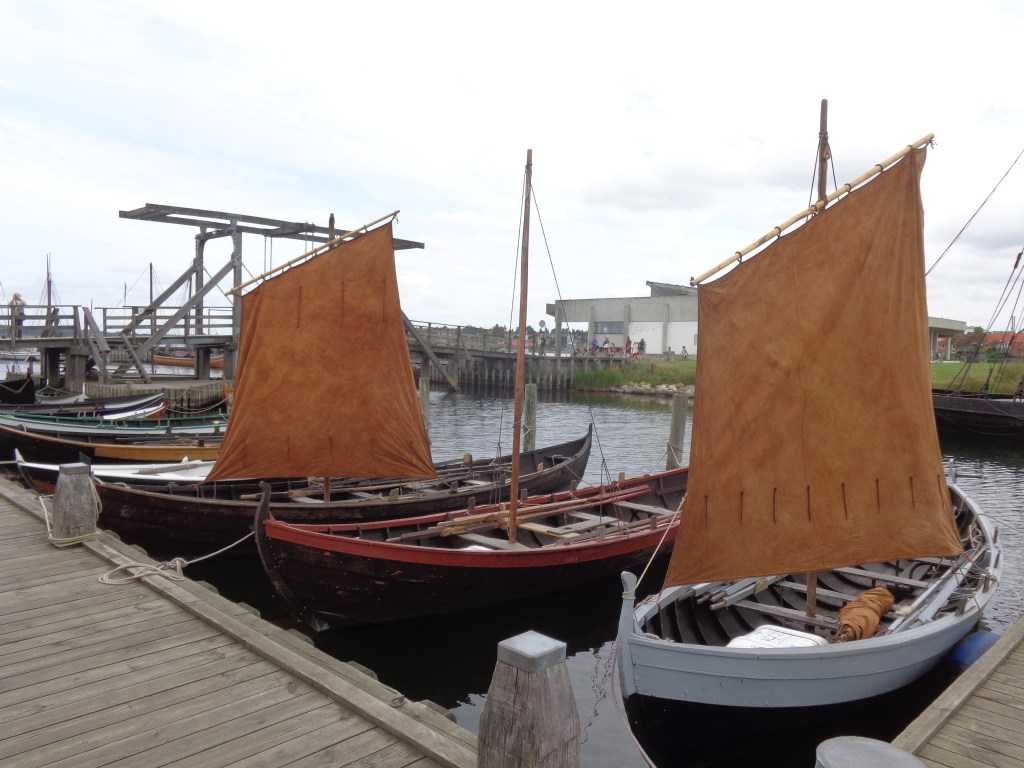
The people who lived here, mainly on the coastal or low-lying lands, had been living in well-organised political and social units since the 6th century. Like the northern Britons, their ancestors would have had some contact with the mighty Roman Empire, including trade, but were not governed by it. The Anglo-Saxon poem Beowulf (and other sources) mentions Hygelac, a Danish king, who was killed by the Franks while raiding in the lower Rhine region and this has been dated to 528.
Evidence of continuing friction with their southern neighbours is seen in the building of the Danevirke, a defensive rampart across the southern neck of the Jutland peninsula in 737. This was later strengthened in 808.
During the second half of the Late Germanic Iron Age (600-800), a number of kingdoms began to emerge.
The Danes are the people we know most about and their kings also ruled into what is now Norway and parts of Sweden. Norway was not a united country and was more a collection of a dozen realms (each with their own “king”). It would not be until around 870 that unification became a serious option and the king who is said to have achieved that was apparently a descendant of a very long line of kings who had originally come from what is now Sweden. His name was Harald Fairhair and his ancestors were the Ynglings – their story is helpfully preserved in the first chapters of Snorri Sturluson’s Heimskringla.
Much of the evidence from this time comes from outside Scandinavia. This is perhaps partially due to the lack of any wholescale written language from Scandinavia at this point. Runes were used but these had limitations and we have to rely on works written in Latin and other languages to let us know what was going on. One of these sources is the Anglo-Saxon Chronicle which was started in the latter decades of the 9th Century but contains information about the period before that, including the first Viking raids on Britain at the end of the 8th century.
Both raiding and trading by the Scandinavians had been happening for some time and as ships and navigation improved and contact increased, the scene was set for further exploration.
The language spoken at this time in Scandinavia was a close relative of that spoken by the Anglo-Saxons, both being a type of Germanic. Anglo-Saxon was an old West Germanic language, as are the Scots and English spoken today. The old North Germanic languages have been classified into Old West Norse (spoken in Norway and then Iceland, Scotland, Faroes, Ireland, Isle of Man, Greenland, northwest England and Normandy) and Old East Norse (spoken in Denmark, Sweden, parts of what is now Russia, eastern England, and Danish settlements in Normandy.)
There was one important difference between the Norse and Anglos-Saxon languages. By the 9th century, Old Norse was mainly a spoken language, and any written form was by use of runes which were carved onto stone and wood rather than parchment. Anglo-Saxon on the other hand had adopted the letters we use today at least 300 years earlier. It wasn’t until the 11th century that Old Norse followed suit.
Old West Norse – the language of the Icelandic Sagas – is very similar to modern Icelandic and Faroese although the pronunciation has changed and can be read without too much difficulty by speakers of Icelandic. The languages on the mainland of Scandinavia have developed considerably from Old Norse into Danish, Swedish and Norwegian but still retain strong links. There is a degree of mutual intelligibility between these, similar to the differences – or similarities – between modern-day English and Scots.

 The Northern Tapestry
Leave a comment