
Bede writes of the five different languages being spoken in northern Britain in the 8th century. These are the languages of the Anglorum, Brettonum, Scottorum, Pictorum et Latinorum*. The first four of these link to distinct groups of people (the English, The Britons, The Scots and The Picts), while the last one is of course Latin, which “by the study of the Scriptures, become common to everyone.”*
This short passage is a useful introduction to the cultural melting pot of the area at that time. The names of the four peoples can be confusing to the modern ear. One group (the Picts) have since disappeared; the other three do not cover the countries or nations we know today. In fact it makes more sense to say that the English were actually German, the Scots were (possibly) Irish, or at least western Scots, The Picts were Northern and Eastern Scots, while the Britons were southern Scots and Welsh. If nothing else, it is important to note that at this stage there was no Scotland and no England; at least not in the modern sense, although these nations would take steps towards their existence during the 8th Century.
Lying to the west of what we know as Great Britain (i.e. the main land mass containing Scotland, England and Wales), Ireland by the end of the 7th century was a Celtic and Christian land where people largely lived in rural communities. Religion – led by the monasteries – played an important role in all aspects of life, as it had done for 300 years or so.
In discussing Irish history before the Vikings arrived, there has been a tendency to highlight five “kingdoms” on the island:
- Ulaid (Ulster),
- Connachta (Connacht)
- Laigin (Leinster),
- Mumu (Munster)
- Mide (Meath),
However, the leading dynasty was undoubtedly that known as the “Uí Néill.” There was a southern branch, based in the middle of the island, and a northern branch. The northern Uí Néill held power in the north-western part of Ireland, pushing into Ulster.
The period of Irish history before c.800 is often referred to as a “golden age” when art and religion combined to produce a level of scholarship and creativity which can be seen in the Book of Kells. However a recent study from Queens University Belfast has suggested that sometime around 700 the population of Ireland started to decline – perhaps because of wars, famine or both. This was a trend that was only reversed when the Vikings arrived.
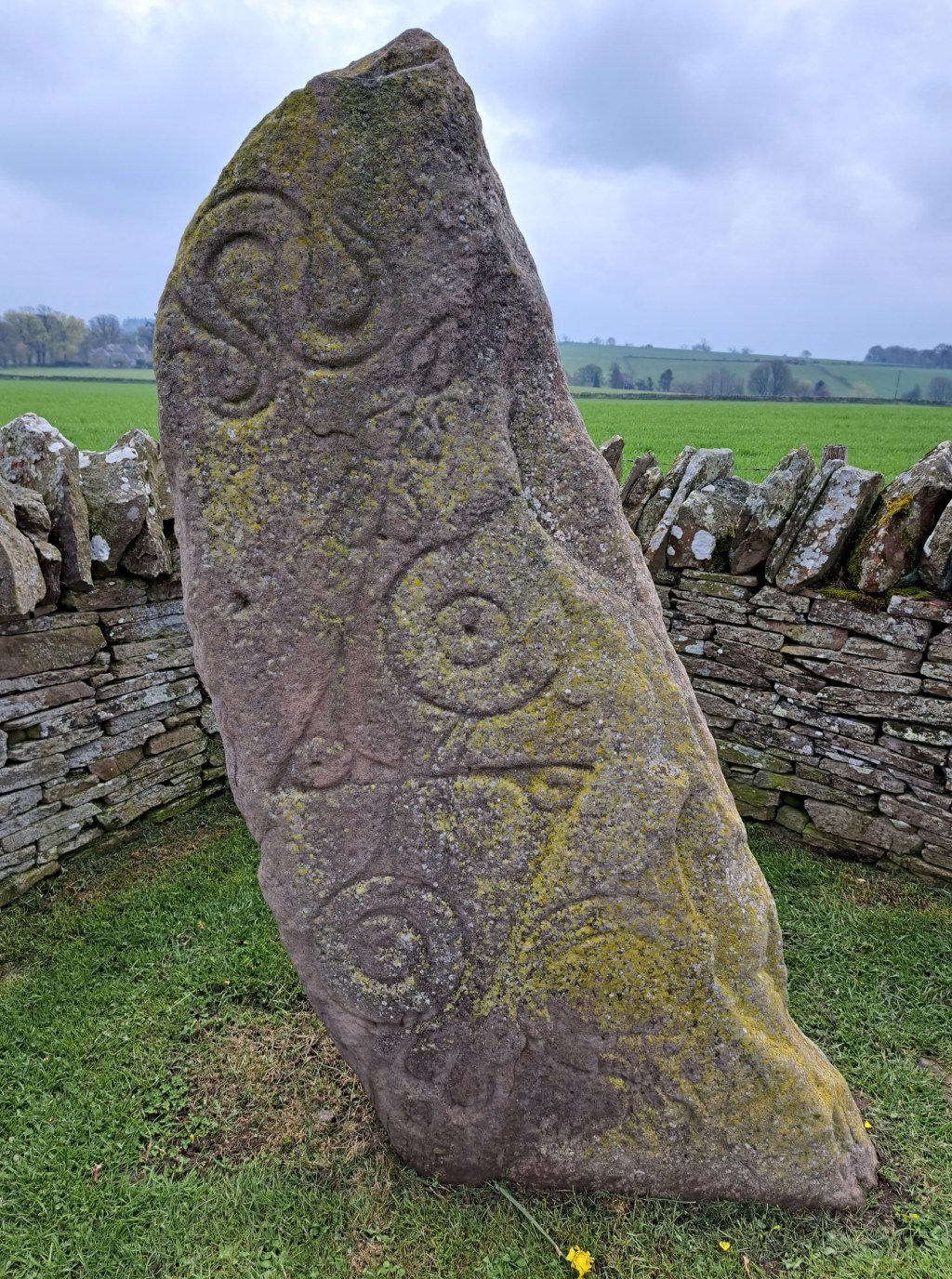
The photo shows a Pictish stone from Aberlemno.
*Haec in praesenti, iuxta numerum librorum, quibus lex diuina scripta est, quinque gentium linguis, unam eandemque summae ueritatis et uerae sublimitatis scientiam scrutatur, et confitetur, Anglorum uidelicet, Brettonum, Scottorum, Pictorum et Latinorum, quae meditatione scripturarum ceteris omnibus est facta communis. (Bede: Historia ecclesiastica gentis Anglorum, 1.1)

 The Northern Tapestry
Leave a comment